
CASE FILE #017 — THE HOUSE THAT WALKS
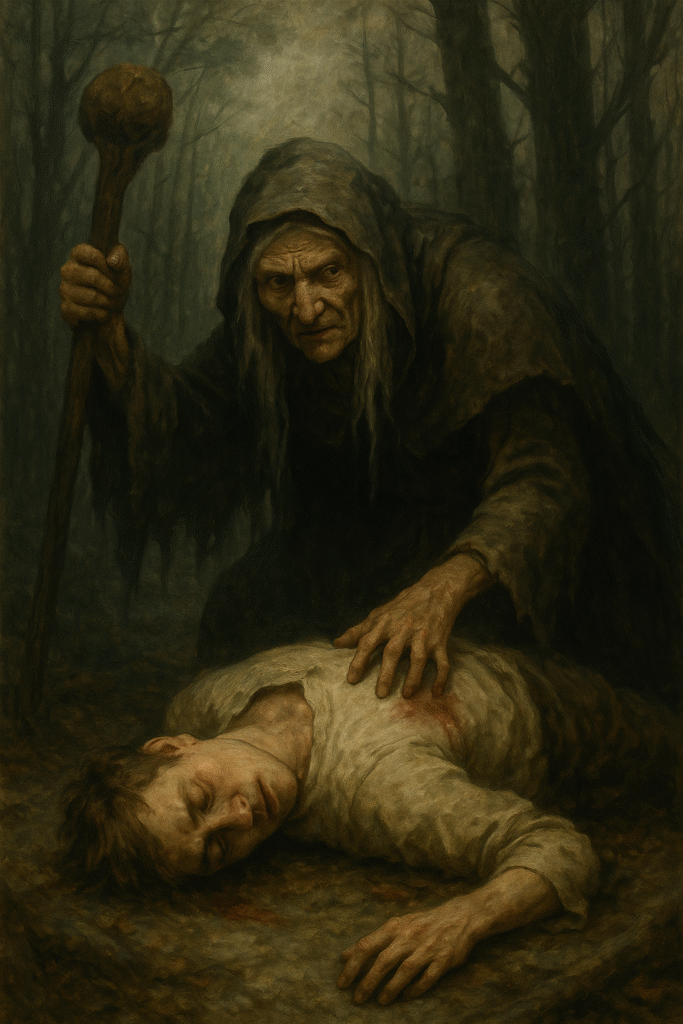
Quick Facts
Region: Eastern Europe — primarily Russia, Ukraine, Poland, Belarus
Also Known As: Yaga, The Bone Mother, Iron-Toothed Hag
Classification: Forest Entity / Witch / Threshold Being
Primary Origin: Slavic folklore, pre-Christian animism
Typical Behavior: Tests, deceives, bargains; abducts travelers; may help if satisfied
First Signs: Blue fire in the woods, bone chimes, or a house standing on tall legs
Weakness (traditional): Iron, salt, true names, cunning bargains
Introduction
Some monsters stalk the woods.
Others become the woods.
Baba Yaga is both.
She is whispered not as a single witch
but as a force —
a living test that appears where society thins
and the wild world begins.
Her home is a riddle:
a wooden hut balanced on towering bird-like legs,
restless and wandering.
The door faces away from all who approach,
until invited —
or chosen.
When the hut turns,
when its window glows blue from within,
the forest holds its breath.
Stories promise she can grant—
or take—
anything.
A child.
A future.
A soul.
But she always asks a price.
And she never names it twice.
This is the record of those who encountered her
and returned enough to speak.
Origins — Before the Cross, Before the Tsars
The name Yaga likely comes from ancient roots meaning
“disease,” “pain,” or “horror,”
but her nature predates language.
She is tied to:
- The edge of the village
- The threshold between life and death
- The wild feminine — unbridled and untamed
Before Christianity reached the Slavic lands,
she was seen not as evil
but as a judge of one’s path —
the witch of crossroads,
keeper of the boundary between world and otherworld.
Children feared her.
Heroes sought her.
The wise left offerings and walked away.
She embodies wilderness older than kingdoms —
and hungers older than prayer.
What Creates a Baba Yaga?
Slavic lore gives many explanations:
The Ancient Witch
A mortal woman who transcended death
through forbidden ritual,
binding her spirit to the forest.
Nature’s Memory
A force born from the wild —
an avatar of decay, rebirth, and judgment.
The Triple Sisters
Some tales claim there are three Yagas —
one maiden, one mother, one crone —
appearing in different forms to test travelers.
In all versions, she is not purely foe nor friend.
She is a threshold made flesh,
demanding the truth of those who cross.
Appearance — The Hag, The House, The Teeth
The Form You See
Many describe Baba Yaga as:
- A towering old woman
- Bones showing beneath skin
- Iron teeth
- Nose long enough to scrape the ceiling
She rides not a horse
but a mortar,
steering with a pestle.
She sweeps her trail away with a broom of bone
so none may follow.
Her voice cracks like burning wood.
Her breath smells of ash and wild herbs.
Some claim she has only one leg —
a symbol of her existence
between worlds.
The House That Walks
The infamous hut:
- Stands on giant bird legs
- Turns its back to all approachers
- Windows pulse with blue fire
- Fences built from bones — topped with skulls glowing at night
The house is alive —
guarding, hunting, choosing.
Some say it selects travelers
long before they reach the door.
Behavior — Judge, Trickster, Devourer
Baba Yaga does not randomly hunt.
She tests.
Those who meet her are judged
not by strength
but spirit.
She asks questions.
Sets tasks.
Bargains.
Fail — and she devours.
Succeed — and she may grant powerful gifts:
knowledge, protection, prophecy.
She is drawn to:
- Lost wanderers
- Children
- Men who boast
- Women seeking what was taken
Sometimes she abducts,
sometimes she shelters.
But every encounter leaves a mark.
Typical Pattern
- Lights flicker in the trees
- Bones or feathers hang in branches
- A house rises over the horizon — on legs
- The door opens itself
- A voice invites
Inside is warmth — food, tea, soft firelight.
But beneath the floorboards,
something whispers.
She will always ask what you seek.
She will always ask what you offer.
Very few answer correctly.
No answer is safe.
Abilities
Threshold Manipulation
Warps space —
travelers wander for days in a forest only miles wide.
Shapeshifting
Appears as young maiden, matron, or crone —
depending on what she wants you to see.
Cunning Bargain
Her gifts always transform —
blessings turn to challenges,
curses become lessons.
Blue Fire
Summons a cold flame for light, ritual, or punishment.
Familiar Command
Wolves, owls, crows, and spirits obey her.
Soul-Testing
Knows a traveler’s darkest truth
without being told.
Documented Encounters
1894 — Białowieża Forest (Poland)
Three brothers vanished.
One returned — gray-haired, raving.
He claimed the house welcomed them inside,
offering a feast.
Then she appeared — tall, thin, smiling.
His brothers screamed beneath the floorboards.
He ran.
Days later, he died of fever.
Villagers barred the forest for a generation.
1932 — The Milk Girl
A missing girl returned unharmed
yet changed.
She said:
“The house follows the moon.”
Her feet were too clean
to have walked.
She never spoke again.
1944 — Partisan Patrol
A group of resistance fighters
vanished without struggle.
Boots found arranged in a perfect circle.
No footprints leaving the site.
A single pot sat in the snow,
still warm.
1967 — Surveyor’s Journal
A forester mapping new roads vanished.
Notebook found nailed to a tree
with a hand-forged iron key.
Final line:
“She is measuring me.”
1998 — Late-Night Call-In
A Warsaw radio show received a call
from a terrified man.
He said he awoke inside a wooden room,
kettle boiling without flame.
An old woman asked:
“Work, feed, or bargain?”
The call ended abruptly.
The station could not trace the number.
2021 — The Floating Window
Hikers reported seeing
a glowing window suspended in the trees.
Through it,
a silhouette moved — elongated, swaying.
When approached,
the window blinked shut.
A month later,
one hiker vanished.
Eggs were found on a stump
beside his abandoned tent.
Regional Variants
Different Slavic regions change her nature:
Russia — The Bone Mother
Fierce, unpredictable;
keeper of forest spirits.
Ukraine — The Fortune Witch
Dispenses prophecy —
but always a double-edged one.
Poland — The Child-Taker
Lures children with warm light
and soft songs.
Belarus — The Threshold Judge
Tests character;
rewards only the righteous…
and even then, rarely.
Cultural Significance
Baba Yaga embodies:
- Terror of the wild
- Fear of getting lost
- Distrust of unknown elders
- The danger of bargains
She is the shadow around the hearth,
the reason children obey,
the whisper that says
the woods are watching.
But she is also wisdom —
the lesson that survival demands cleverness,
courage, honesty.
She destroys the unworthy
and reshapes the strong.
Protection & Weakness
Safeguards
- Iron
- Salt
- True names
- Politeness
- Clear purpose
Weakness in Lore
- Iron nails placed at the threshold
- Drawing protective circles
- Outsmarting her riddles
But most tales warn:
If the house has already chosen you,
no charm will save you.
Symbolism & Interpretation
Baba Yaga represents:
- The liminal
- The feminine wild
- The boundary between worlds
She blurs the line between:
Teacher and destroyer
Guide and executioner
Mother and monster
Her stories endure
because every traveler fears
the moment he no longer recognizes the path.
And every child fears
the knock at the door
when no one should be standing there.
Why Her Legend Lives
Because we still fear:
- Forests at night
- Roads we do not know
- Voices that whisper our names
- Doorways that open by themselves
Baba Yaga is not feared because she kills.
She is feared because she chooses.
She demands no worship.
Offers no mercy.
Only truth.
And truth costs.
Conclusion
The house stands on high legs,
waiting.
A lantern flickers within.
The door creaks.
A voice — old as storm and smoke —
asks a question.
She does not beckon.
She expects.
And if you step inside,
if you take the bargain…
the path you walk afterward
will never be the one you knew.
For those who find the house
are never truly lost.
They are measured.
And the woods
always remember the answer.