
Nuckelavee – The Skinless Rider of the Tides
Origins — Of Brine, Blood, and Burning Kelp
The name “Nuckelavee” likely stems from the Orcadian word knoggelvi, and is possibly connected to the Norse nokk or nuggle, water spirits known for dragging people to drowning deaths. But this is no trickster kelpie.
The Nuckelavee is a demon — not merely of the sea, but of rot, plague, and ruin.
Birth of the Legend
Islanders whispered of it long before pen met parchment. By the 16th century, sea-bound communities across Orkney and Shetland feared a monster that emerged from salt waves to scour the land.
It appears in:
- Oral accounts passed through generations
- 19th-century writings by folklorist Walter Traill Dennison
- Stories explaining cattle plagues and failed harvests
Not a beast of the woods nor skies. It rises from the sea. With flayed skin and steaming breath.
Some say it is vengeance from the deep. Others say it is the deep — made flesh and fury.
Always, it brings death.
What Creates a Nuckelavee?
Folklore offers few paths, but all end in horror:
- A spirit cursed by the Mither o’ the Sea — Loosed only when her strength fades in winter.
- A drowned soul warped by vengeance — Fused to beast and bound to blight the land.
- A demon born of sea smoke and kelp ash — Birthed in the age when man first scorched the shore for gain.
Whatever its source, it is not a being of balance. It is hunger. Hate. Decay incarnate.
It is what comes when the sea no longer forgives.
Appearance — Skinless and Split
The Form You See
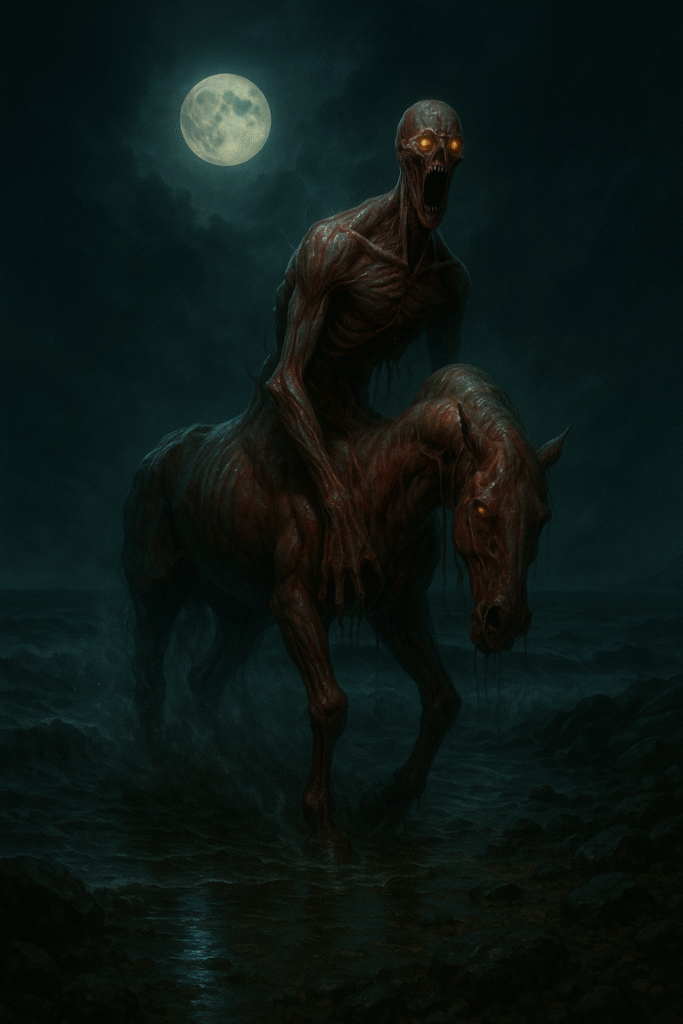
When it rises from the surf, those who live describe:
- A horse-like body, grotesque and swollen
- No skin — raw red muscle and black veins exposed
- A massive head, too large for its frame, lolling side to side
- A single red eye burning like forge-coal
- A long maw like a pig’s snout, venting black vapor
- Legs ending in fins or flipper-like hooves
Riding its back… is itself:
- A humanoid torso fused to the horse-body
- Arms dragging down to the earth
- Joints too long, fingers clawed
- Head rolling as if broken
- And like the beast below, entirely skinless
It glistens in the moonlight. It stinks of carrion and tide.
The Truth Beneath
If enraged or pursuing prey:
- Its eye glows hotter — bright enough to sear
- Its breath blackens crops where it lands
- Its strength doubles as it bellows
- Veins pulse visibly, streaming tar-thick blood
- Its cry is no voice — but a storm howling through bones
Some say it leaves no tracks. Only withered grass and panic.
Behavior — A Curse That Walks Ashore
The Nuckelavee does not need provocation. It seeks. It scours.
It is drawn to:
- Winter shores
- Dry spells
- Kelp fires and villages near brine
- Livestock left untended
It walks where sea meets land. It breathes blight into the earth.
Typical Pattern
A warm night after a drought A strange breeze over the loch A stench like rot and sulfur
Then:
- A shimmer on the sea
- Hoofbeats, wet and slow
- The air grows foul
- The cattle panic
- The crops begin to wilt
By morning, there is death. And silence.
Abilities
Toxic Breath
Its exhale spreads disease. Crops rot. Horses foam at the mouth. Humans sicken within hours.
Sea-Borne Immortality
It cannot be killed by mortal means. It flees only when forced.
Supernatural Strength
Its fused form possesses immense speed and power. It can outrun horses and tear down gates.
Paralytic Fear
Most who see it cannot move. Even strong men collapse in its presence.
Seasonal Curse
Bound by the Mither o’ the Sea, it is strongest when her power wanes — late autumn through early spring.
Regional Variants
Shetland (Mukkelevi)
- Same skinless form
- More aquatic; appears near boat wrecks
- Blamed for sudden sailor drownings
Orkney Mainland
- Associated with kelp-burning curses
- Tied to livestock plagues like Mortasheen
Stronsay Island
- Said to haunt peat paths and sea-lochs
- Breath alone kills plants for leagues
Modern Sightings
Few claim to see it now.
But tales persist:
- Farmers finding herds dead by blackened grass
- Burnt seaweed piles steaming in windless air
- Teenagers chased from sea-caves by something slick and stinking
In art, it appears in:
- Fantasy novels (e.g. The Stones Are Hatching)
- Horror podcasts and monster bestiaries
- Grimm creatures in modern animation
Its name remains a whisper. Often followed by a prayer.
Cultural Significance
The Nuckelavee reflects:
- Fear of the sea’s wrath
- Trauma from famine and plague
- Guilt over exploiting land and ocean
- Dread of winter without protection
It is both:
Warning Punishment
A force older than church or coin. A demon remembered not for belief. But because every islander once knew someone who heard hoofbeats after dusk.
Protection & Weakness
Traditional Safeguards
- Cross running water
- Pray to the Mither o’ the Sea
- Carry cold iron
- Avoid burning kelp on windless nights
Weaknesses (in lore)
- Rainfall (fresh water burns it)
- Streams and lochs (it cannot cross them)
- Naming it aloud (some say this breaks its glamour)
But most stories agree:
If the Nuckelavee has risen, you are already too late.
Symbolism & Interpretation
The Nuckelavee is not just horror. It is consequence.
For every field burned for greed, For every boat pushed too far, For every offering left undone—
The sea sends back its own. And it does not forget.
It is not a monster. It is a memory with muscle and breath.
And it walks until appeased.
Conclusion
The tide pulls back. The kelp lies still.
But the wind carries something with it — A smell. A sound.
The gulls fall silent. Your horse rears. Your lantern dims.
And from the mist a hoof falls on stone. Then another.
You turn. And it turns with you.
It does not need to chase. Only follow. Until all the green is gone and the air is black.
The Nuckelavee does not kill. It unmakes.
And it is coming inland.