
The Hollow Man — A Presence That Erases
Quick Facts
Region: Europe, North America, Southeast Asia
Also Known As: The Faceless Watcher, El Hombre Hueco, L’homme Creux, The Whisperer Beyond the Pines
Classification: Identity-draining specter / parasitic cryptid
Primary Origin: Forgotten soul or spectral husk
Typical Behavior: Stalks the grieving, lures through mimicry, feeds on memory and warmth
First Signs: Sudden cold, voice of a loved one calling from the dark, shadow at the edge of vision
Weakness (traditional): Reflections (mirrors), strong identity, light and companionship
Introduction
You forget what you were doing.
Then your name slips from your lips like a dream you can’t remember.
You look up, and something is standing just beyond the mist — tall, thin, unmoving. Watching.
That’s how it begins.
Some disappear entirely. Others are found days later, mumbling names no one recognizes, faces blank, mirrors refusing to reflect them. Their bodies are intact, but what made them themselves is gone.
They met the Hollow Man.
Origins
When a person is lost, what remains?
The Hollow Man is not a traditional ghost, nor simply a cryptid. He is a paradox made flesh — the residue of someone forgotten by time, memory, and name. While his story spreads primarily through modern sightings and creepypasta, his roots stretch deep into pre-modern European and American folklore.
In Germany’s Black Forest, old woodcutters feared Der Hohle Mann — the Hollow Man — a faceless being who came to the lonely. In France, he was L’homme Creux, a soul lost between death and remembrance. In Appalachian tales, he was the one who whispers to you in the woods, using your mother’s voice — but your mother is dead.
In each of these, his essence remains the same:
A thing that used to be someone.
And it hungers to be someone again.
What Creates a Hollow Man?
While no single tale explains his origin, multiple traditions echo the same possibilities:
- A person who died nameless and unloved
- A suicide in an unmarked place
- A soul consumed by sorrow or erased by others
- A vessel abandoned by its spirit
- A human manipulated or possessed by something older
In some variants, he’s not a spirit at all — but a shell animated by a parasitic force.
A walking hunger.
An echo of despair.
Appearance — Emptiness Made Visible
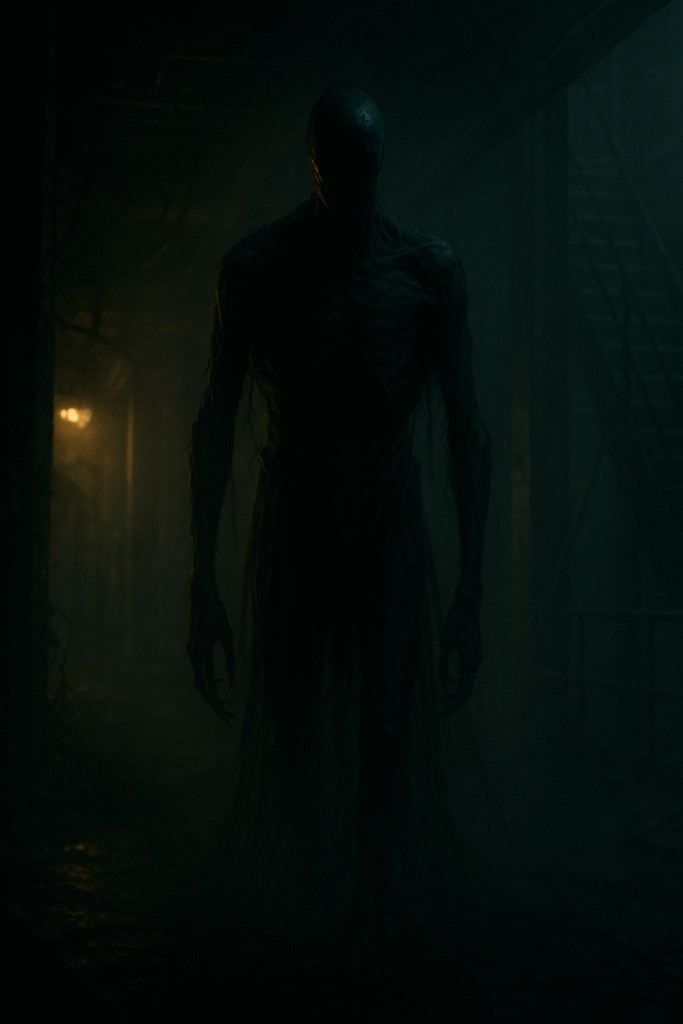
From a distance, the Hollow Man appears human.
Until he doesn’t.
The Form
- Height: Around 7 feet
- Limbs: Too long. Fingers extend unnaturally.
- Skin: Thin, gray or translucent black
- Face: No features — only smooth indentations
- Light: A dim glow flickers inside the void of his head
- Movement: Unnatural stillness followed by sudden, silent closeness
In the right light, he’s see-through, like a ghost made of ash.
In fog, he’s barely visible — yet unmistakably there.
And when he opens his mouth, it shines like a lantern — but the light brings no warmth.
Up Close
Those who survive describe the same feeling:
“He looked inside me, and something left.”
His gaze is said to strip away your sense of self.
It doesn’t matter if you scream — he doesn’t listen.
It doesn’t matter if you run — he doesn’t chase.
He simply watches… until you’re hollow too.
Behavior — A Predator of Memory
He does not hunt like animals do.
He does not need to.
When He Appears
- After grief
- During moments of deep isolation
- In forests filled with fog
- Near abandoned buildings
- In rooms where someone has just died
Witnesses often report:
- Voices calling them by name
- A sudden drop in temperature
- Shadows lengthening without a light source
- Familiar laughter from someone long dead
- An urge to turn around — even when they’re alone
Who He Targets
- The grieving
- The suicidal
- The unloved
- The forgotten
- Those who speak their own name aloud while alone
He is drawn to people who are already disappearing from the world — emotionally or socially. He finishes what despair starts.
Abilities
The Hollow Man doesn’t kill.
He unravels.
Memory Erosion
- Victims forget key facts: names, faces, birthdays
- Some lose speech entirely
- Mirror reflections lag or vanish
- Electronic devices erase saved images
Voice Mimicry
He speaks using voices from your life:
- Lost siblings
- Ex-lovers
- Dead pets
- Yourself
It always sounds just close enough to trust — just far enough to doubt.
Heat & Light Drain
He pulls warmth from surroundings:
- Fires die
- Batteries fail
- Warm bodies go cold
His presence often leaves behind signs of hypothermia — even in summer.
Possession (Rare Accounts)
In some lore, the Hollow Man is a puppet.
Something lives inside him — stitched muscle controlled by invisible hands.
In these tales, he can:
- Load a rifle
- Open a door
- Speak a single word, then collapse like an empty coat.
Regional Variants
Europe
Faceless phantom who appears to those without family. Known to knock softly on doors during wakes.
North America
Appalachian “Whisperer Beyond the Pines” — said to walk mountain roads under the fog. Children warned never to follow the sound of their own name.
Latin America
“El Hombre Hueco” appears after tragic accidents. Some say he feeds on guilt. Others burn sage to drive him away.
Southeast Asia
Recently merged with legends of lost souls and shadow people. Said to appear outside second-floor windows during heavy rain.
Encounters
Collected Case: The Campfire Collapse
In 2010, a group of teens camped deep in the Sierra Nevadas.
They drank. Partied. Slept by a fire.
By morning, three were dead.
The fourth was found standing in the middle of the trail—barefoot, frostbitten, and whispering a name no one knew.
His report:
“We saw something… it didn’t move. Just stared. And then the fire went out.”
Signs of Manifestation
- Light dimming without power failure
- Your name whispered where no one is
- Seeing someone tall and still at the edge of vision
- Cold that “feels emotional” — not just physical
- Items rearranged subtly
- Memory slips during periods of isolation
- Your voice mimicked back at you, imperfectly
Weaknesses and Protection
While nothing is guaranteed, folklore offers tools:
Mirrors
Reflections remind him of what he lacks.
Placing a mirror between yourself and him may cause hesitation.
Note: Mirrors have been known to crack or fog in his presence.
Companionship
He prefers the lonely.
Don’t go quiet places alone after a loss.
Bright Light
Flares, high beams, floodlights — all can delay his approach.
Memory Anchors
Reciting your full name, repeating your past aloud, holding onto objects that define your identity — these may slow the hollowing.
Don’t Answer
The most important rule:
If someone calls your name from the dark — do not reply.
Cultural Importance
The Hollow Man is more than a cryptid.
He is a reflection of modern alienation:
- People mourning alone
- Those forgotten by society
- The fear of losing oneself to depression, dementia, or disconnection
He is the monster you summon by being forgotten.
By forgetting yourself.
His myth lives on because we fear exactly what he represents:
disappearance without death.
Why His Legend Persists
In a world where more people live alone…
Where names fade from obituaries quickly…
Where memories vanish into cloud servers…
The Hollow Man feels less like a ghost story and more like a warning.
You don’t see him until you feel him.
And by then, you’ve already forgotten something important.
Conclusion
The Hollow Man does not scream.
He doesn’t lurch from closets or rattle chains.
He simply waits for the moment you let go of yourself — and steps in.
He is a ghost story for the digital age.
A myth shaped by grief.
A shadow that feeds on the absence of love, memory, and connection.
He doesn’t just kill.
He erases.
And when he leaves, no one remembers you were ever there.