
Black Shuck — The Hell Hound of the English Coast
Quick Facts
Region: Eastern England (Norfolk, Suffolk, Essex)
Also Known As: Old Shuck, Galleytrot, Black Dog, Devil’s Hound
Classification: Spectral canine / Death-omen spirit
Primary Origin: Medieval English coastal folklore
Typical Behavior: Stalks travelers at night; appears as an omen of death; sometimes protects the lost
First Signs: Heavy footfalls behind you; glowing red or green eyes; silence in wind and waves
Weakness (traditional): Church symbols; iron; running water
Introduction
The wind howls across the salt marshes.
The moon hangs low.
And somewhere in the dark — paws strike the earth, soft as passing waves.
You don’t hear breathing.
You don’t hear growling.
Only the quiet scrape of claws on ancient stone.
Then you see him.
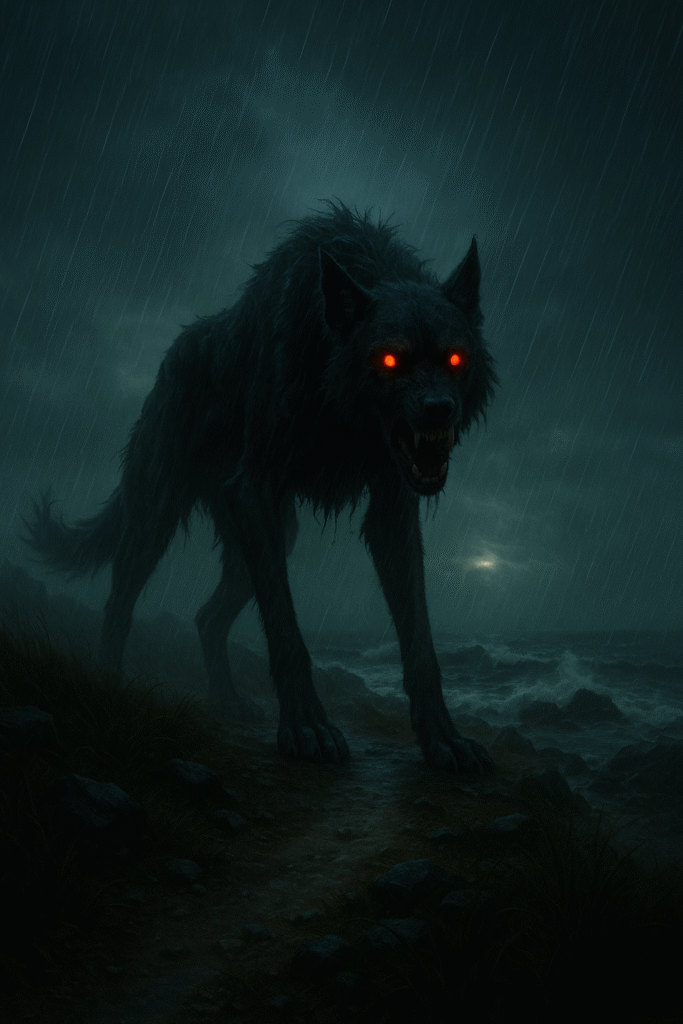
A massive hound:
Matted black fur swallowing the moonlight,
Eyes burning like coals,
A shadow twice the size of any mortal dog.
He follows.
Never rushing — only watching.
Some who meet his gaze live only days longer.
Others are found with hair white as frost,
Hearts burst in their chests.
This is Black Shuck — the ghost hound of East Anglia,
A terror older than tombs and tides.
Neither wholly evil nor benevolent,
He is the boundary between this world and the next.
This case file follows the Shuck’s trail —
From medieval accounts and church burnings
To modern reports lingering along lonely coastal roads.
Origins — Of Salt, Shadow, and Church Bell
The name “Shuck” likely stems from the Old English scucca, meaning demon or scoundrel.
He is no ordinary wild dog — but a supernatural beast linked to death, storms, and the Devil.
Birth of the Legend
During the Middle Ages, coastal villages whispered of a great black dog roaming the dunes during storms. Sailors said he came ashore on fog-soaked nights, guiding lost souls or claiming them.
He appears in:
- Church records (1577)
- Poems and local ballads
- Trial accounts of witches who claimed him as familiar
Unlike wolves or mastiffs, Shuck is not flesh and blood.
He walks between worlds —
A shadow that watches, chooses, and judges.
Some say he hunts the wicked.
Others say he simply warns.
Always, he follows.
What Creates a Black Shuck?
Folklore offers several explanations:
- A hellhound born from the Devil’s breath
— A harbinger of damnation. - A guardian spirit of the dead
— Charged to escort souls to the afterlife. - A specter of tragedy
— Formed from drowned sailors or murdered travelers.
In every story, he is a boundary being —
Neither enemy nor ally,
Only inevitable.
Appearance — Night with Eyes
The Form You See
When he chooses to appear, witnesses describe:
- Size of a horse or calf
- Fur blacker than moonless sky
- Eyes glowing red or green
- Walks silently or with thunderous steps
- Sometimes chains or mist cling to his body
He may appear on roads, beaches, graveyards, or storm-swept cliffs.
Some say he has no head,
Only burning eyes floating in shadow.
Others claim his feet never touch the ground.
The Truth Beneath
If revealed or enraged:
- Body distorts into a moving shadow
- Jaws expand impossibly wide
- Breath smells of seawater and grave soil
- Eyes burn through stone
- Footsteps echo inside the victim’s mind
Some stories claim he can pass through walls and doors,
Leaving scorched footprints where he stands.
Behavior — A Death That Walks Beside You
Black Shuck does not chase.
He accompanies.
He is drawn to:
- Lonely travelers
- Seafarers
- Adulterers and oath-breakers
- Those grieving or expecting death
Sometimes he walks beside the living for miles.
Sometimes he appears at their bedside.
Typical Pattern
- Night falls suddenly silent
- Footsteps approach behind the traveler
- A massive black hound appears
- It looks — and follows
- When the traveler reaches safety…
the Shuck vanishes
Days later,
someone dies —
often the one who saw him,
or someone close to them.
A warning.
Or a promise.
Abilities
- Spectral Manifestation
Appears and vanishes at will; passes through matter. - Death Omen
Sightings often precede death — by illness, accident, or tragedy. - Psychic Presence
Victims feel dread, heaviness, or whispered voices. - Night Travel
Crosses great distances silently; outruns horses. - Mortality Marking
Touch or gaze can cause hair to whiten, hearts to fail. - Dual Nature (in some tales)
Can protect children and lone travelers —
especially from violent men or other spirits.
Regional Variants
Bungay & Blythburgh, Suffolk
The most infamous story.
On August 4, 1577, a storm struck.
A black hound burst into St. Mary’s Church (Bungay) —
killing two parishioners, leaving scorch marks on the door.
Minutes later, it appeared at Holy Trinity Church (Blythburgh) —
killing more.
Claw marks still scar the church door.
Essex Coast
Seen guiding sailors to shore —
or pulling them beneath the waves.
Norfolk Marshlands
Appears to travelers lost in fog,
sometimes leading them home —
other times leading them astray.
Modern Sightings
Drivers report a huge black dog on deserted roads.
It vanishes upon collision —
no body, no blood,
only scratch marks along the car side.
Hikers tell of pawprints appearing beside them,
though no dog was seen.
In seaside towns,
people hear heavy footsteps behind them —
always stopping when they turn to look.
Red eyes watch from dunes at night.
Even skeptics avoid the marshes at dusk.
Cultural Significance
Black Shuck reflects:
- Fear of the unknown roads and lonely coastlines
- Anxiety around death and fate
- Respect for forces beyond understanding
He is both:
- Harbinger
- Guide
A reminder that death walks close —
sometimes beside us.
Protection & Weakness
Traditional Safeguards
- Crosses or holy symbols
- Iron nails or blades
- Avoiding crossroads at midnight
Weaknesses (in lore)
- Church bells
- Protective charms
- Crossing running water
But most stories agree:
If Black Shuck has chosen you,
no charm will save you.
Symbolism & Interpretation
The Shuck’s message is simple:
Death is coming —
but whether he brings warning or deliverance is unknown.
He blurs the line between:
- Terror and protection
- Curse and mercy
- Omen and companion
He is the shadow we sense
walking behind us
when no one is there.
Why His Legend Lives
Because we still fear:
- To walk alone at night
- To hear footsteps where no feet tread
- To feel eyes upon us in the dark
The Black Shuck is not feared because he kills —
but because he watches.
He demands no worship.
Leaves no bargain.
Makes no threat.
Only presence.
Quiet.
Endless.
Inevitable.
Conclusion
The sea wind rises.
The marsh grass bends.
A low growl carries through the mist —
but no beast is seen.
You walk faster.
Someone follows.
Never close — but never far.
You reach home.
Lock the door.
The sounds fade.
But his eyes are still with you.
Black Shuck does not need to strike.
He already knows your name.
And when the time comes,
he will return
to walk beside you
one last time.