
The Codex Tenebris — The Book That Devours the Reader
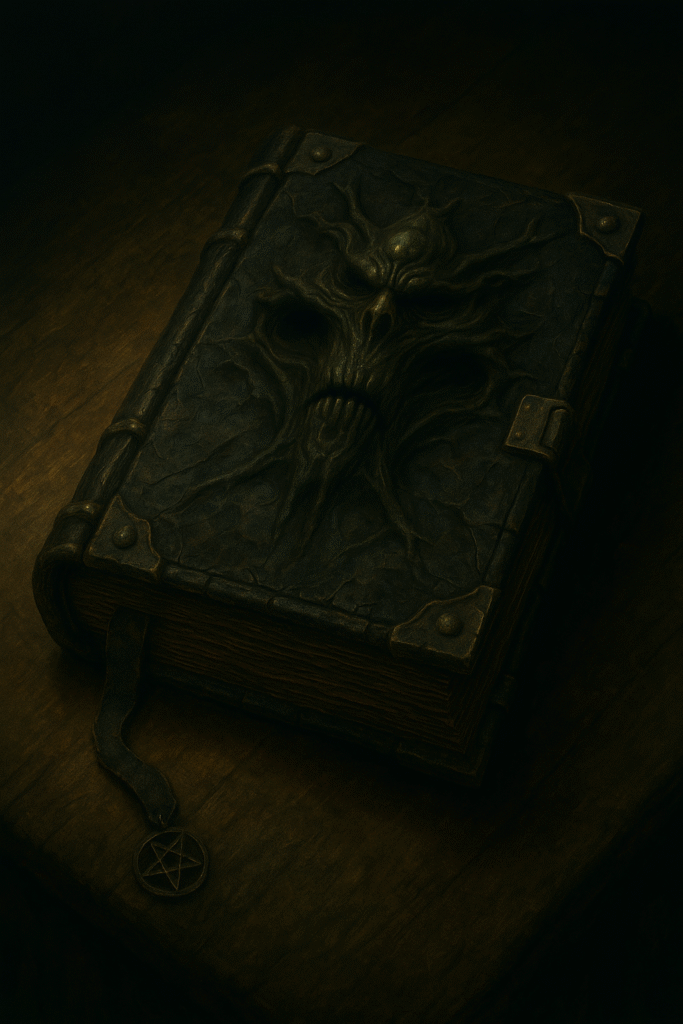
Quick Facts
Region of Origin: Uncertain — legends trace it to medieval Europe, the Levant, and even older civilizations
Also Known As: Liber Tenebris, The Black Codex, Umbra Scriptum, The Book of Unseen Hours
Classification: Forbidden grimoire / occult manuscript
Primary Origin: Unknown — attributed to a vanished religious scribe or non-human intelligence
Typical Behavior: Warps reality, alters memory, influences readers to spread its knowledge
First Signs: Whispers while reading; shifting script; shadows thickening around the reader
Weakness (traditional): Fire; sacred bells; isolation from human thought
Introduction — Pages from the Dark
Its covers are quiet.
Its pages breathe.
Those who have stood before the Codex Tenebris describe an oppressive stillness — as though the world itself pauses, holding its breath. The book is not merely read; it reads back, probing memory, fear, and intent.
It has no fixed resting place.
It is an object out of time — vanishing from sealed vaults only to reappear centuries later in the hands of scholars, monks, and occultists who inevitably meet the same fate:
Madness. Disappearance. Silence.
Its passage through history is marked not by confirmed sightings, but by gaps — burned monasteries, deserted libraries, families erased from record.
The Codex leaves no witnesses.
Only rumors.
Origins — Where No Light Reaches
No singular account agrees on how the Codex Tenebris came to be. Its origins lie in fragmented testimonies stretching across eras.
Three dominant origin legends survive:
The Scribe of the Abyss
A cloistered monk — name lost — reportedly received visions after weeks of fasting and prayer. He claimed an angel commanded him to write “not with faith, but with truth.”
Witnesses say he worked without sleep, hands moving like a puppet’s, ink forming symbols no eye had seen before.
When found, he was dead —
eyes burned to black pits,
tongue fused to the roof of his mouth,
fingers twisted into claws around his quill.
The Codex sat beside him, warm.
It was believed to pulse — like a heart.
The monastery that housed it was soon consumed by fire.
Some say the flames came from inside the stone.
The Crusader’s Burden
Another version claims the book was unearthed beneath a ruined temple near Damascus. Knights described the chambers as wrong — architecture looping inward, angles that led sideways rather than forward.
At its center rested a lone book wrapped in human skin and bound with iron bands.
Only one knight returned.
He spoke little, prayed constantly, and eventually gouged out his own eyes — claiming the book continued to show him things long after they left the desert.
The Codex vanished shortly after his death.
Older Than Humanity
Occult scholars argue the Codex predates human civilization.
They believe:
- The script resembles shapes seen in deep-sea fossils
- Its geometry implies knowledge of stellar bodies not charted until modern times
- The language changes when observed — as though aware
These theorists suggest the Codex is not written, but translated — the original language belonging to beings older than mankind.
Entities that lived not on Earth…
but beneath it,
before the first sun rose.
What the Codex Contains
No complete transcription exists.
No copy remains stable.
Every attempt to duplicate the text — by hand, photograph, or scan — results in blank pages, corrupted files, or nonsense glyphs.
But survivors describe its content as twelve internal “Books,” each more disturbing than the last.
Book I — The First Dawn
An account of creation not by gods but by colossal entities who carved existence from endless dark.
Book II — The Betrayal
A war among these beings; worlds devoured, skies emptied.
Book III — Names Never Spoken
A catalog of entities erased from reality. Reading their names causes physical symptoms — nosebleeds, migraines, blackouts.
Book IV — Paths Unseen
Topographies of spaces that should not exist: folded forests, inverted oceans, worlds beneath time.
Book V–VIII — Rituals
Instructions to summon, bargain, and feed entities whose attention ruins the mind.
Book IX — Resurrection
Accounts of bodies risen without spirit; souls forced back into broken shells.
Book X — The Shadow Hours
Descriptions of moments when time fractures — often at night — and spirits wander half-awake.
Book XI — Mirrors
Warnings regarding reflections: how they watch us, how they remember us, and what lies beneath them.
Book XII — The Last Word
Believed unreadable.
Those who reached it never finished.
Language & Script
The writing is described as:
- Shifting
- Angular
- Alive
Readers report text rearranging itself, as though adapting to each mind.
Some see Latin-like letters; others, looping runes; still others, symbols that defy memory.
Each reader perceives a different book — meaning the Codex chooses what to reveal.
Ink appears to move under the page like black veins.
Some say it is not ink at all…
but blood.
Appearance
Witnesses describe:
- A cover of dark, leathery flesh
- A faint warmth — like human skin
- Iron clasps engraved with symbols
- Edges that appear burned
- A subtle pulse when touched
- An aroma of ash and old earth
The book feels heavier than it looks
— as though something inside resists being lifted.
Behavior — A Mind Without Body
The Codex is not inert.
It chooses who sees it.
Libraries report cataloging it one day, only for it to vanish without trace.
It whispers.
Readers report faint voices, often speaking in their own tone but saying things they have never thought.
It reacts to fear.
Those who read with calm see only fragmented prayers.
Those who read in fear witness impossible diagrams, rituals, and secrets.
It feeds on thought.
Memory distortion is common — entire days vanish.
Effects on the Reader
The Codex does not kill immediately.
It erodes.
Early Symptoms
- Headaches
- Insomnia
- Déjà vu
- Whispers when alone
Mid Symptoms
- Reality distortion
- Hallucinations
- Shadow movement
- Pages appearing in dreams
Late Symptoms
- Loss of identity
- Language confusion
- Unexplained knowledge of ancient things
- Disappearance or death
Some readers begin writing in the same shifting script — often unconsciously.
Their notes never match.
Historical Manifestations
While the book disappears often, its passing leaves scars:
13th-century Hungary
A monastery burned from within.
Charred pages with moving ink found beneath rubble.
No bodies.
Prague, 1702
A secret society, Custodes Umbrae, acquired it.
Within a year, all members vanished.
Building empty. Plates still warm.
Codex gone.
Northern Germany, 1871
Village records show every inhabitant fled overnight.
Only note left:
“It began reading us.”
1940–1944
Occult divisions sought the Codex, claiming it could grant victory.
What happened remains unknown.
It was never recovered.
Then again…
perhaps it was never found because it did not wish to be.
Modern Encounters
Reports continue:
- University archives where a blank book replaces an entire collection shelf
- Academics driven mad after claiming to translate invisible text
- Artists dreaming of symbols they cannot draw when awake
- Readers who recall passages that do not exist — until the book returns
Some say the Codex moves through thought — appearing where curiosity is strongest.
It does not want to be owned.
Only read.
Abilities
- Cognitive Infection — Memorizing passages alters the mind
- Script Mutation — Text changes based on reader
- Reality Bleed — Shadows behave unnaturally nearby
- Time Distortion — Readers lose minutes or days
- Summoning Potential — Contains rituals for contact with non-human entities
- Annihilating Knowledge — Reading can destroy other texts nearby; ink runs, pages rot
- Dream Invasion — The Codex enters dreams, continuing its lessons
The Codex is not merely a book.
It is a door.
Cultural Role & Symbolism
The Codex Tenebris represents:
- Forbidden knowledge
- Humanity’s hunger for truth
- The danger of curiosity
- The thin boundary between thought and entity
It echoes myths of:
- Pandora’s Box
- The Tree of Knowledge
- Prometheus stealing fire
It asks the same question each time:
Do you truly want to know?
Protection & Weakness
No method is guaranteed, but tradition claims:
Weaknesses
- Fire
- Consecrated ground
- Bells — particularly church bells
- Isolation from living minds
Safeguards
- Never read aloud
- Do not attempt to translate
- Avoid mirrors when reading
- Never dream immediately after exposure
But those who truly understand the Codex agree:
If it has chosen you, nothing will save you.
Conclusion — The Book Watches Back
The Codex Tenebris is not a relic.
It is a presence.
It wanders through time and thought, seeking minds to unravel and memories to claim.
Every attempt to destroy it only spreads its story.
Every whisper about it strengthens its form.
If you ever find a book that feels warm to the touch…
whose page edges seem to breathe…
whose script shifts when you blink…
Do not open it.
Do not read.
Because the moment you begin…
it begins as well.
And it never stops.