
The Draugr — The Dead Who Refuse Their Grave
Quick Facts
Region: Iceland, Norway, Faroe Islands, Scandinavia
Also Known As: Aptrganga (“Again-Walker”), Barrow Wight, Haugbúi, Norse Revenant
Classification: Undead warrior spirit / physical revenant
Primary Origin: Icelandic sagas and Viking burial lore
Typical Behavior: Guards grave mounds, crushes livestock, curses the living, stalks travelers at night
First Signs: Freezing wind from burial mounds, heavy dragging footsteps, glowing eyes in the dark, corpse-stench on the breeze
Weakness (traditional): Decapitation, burning, re-burial with runes, sealing grave with “hell-shoes”
Introduction — When Winter Breathes Through the Dead
There are places in the far north where winter never fully releases its grip — where snow clings to the ground even in summer, where the wind whistles through ancient longship ruins, and where burial mounds rise like frozen sentinels above the land.
The locals leave those mounds untouched.
They walk around them.
They lower their voices as they pass.
Because the old sagas warn of what happens when a grave is disturbed.
They say the earth shifts.
The stones tremble.
And something inside begins to breathe again.
A low, wet groan leaks through the soil — slow, strained, as if the lungs beneath it have not tasted air in centuries.
The mound cracks open.
And the Draugr rises.
Not as a spirit.
Not as a whisper.
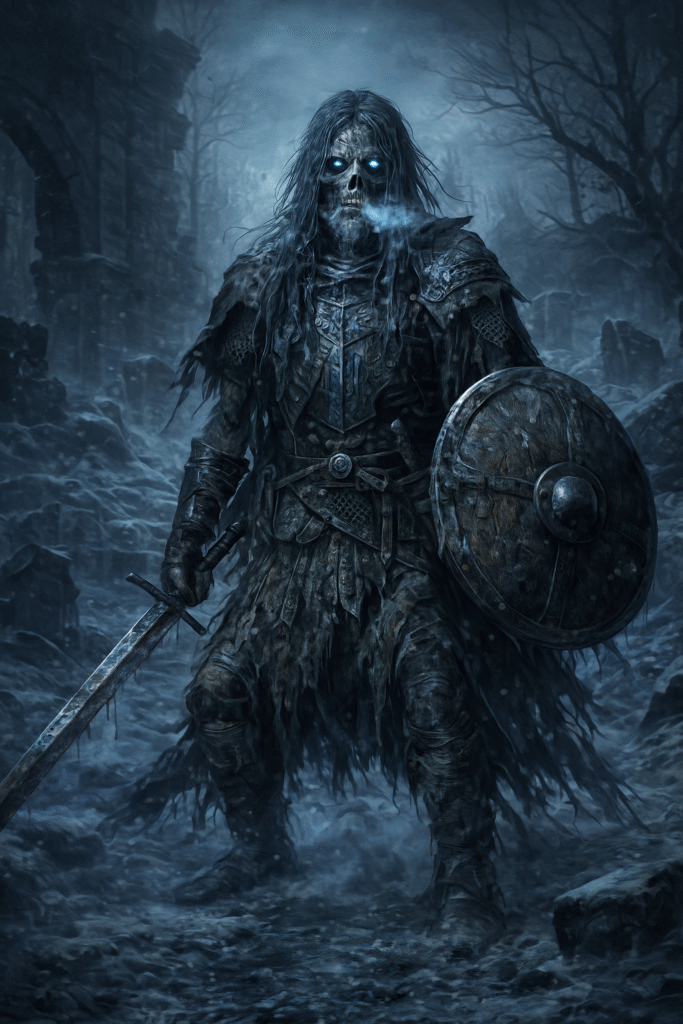
But as a corpse, swollen and blackened, wrapped in burial clothes stiff with age, its eyes glowing like cold embers abandoned on the edge of a dying hearth.
Across Iceland, Norway, and the North Atlantic, fishermen, shepherds, and wanderers have whispered of these revenants since before Christianity touched the fjords. They speak of creatures that leave their graves at night, crushing livestock beneath their weight, breaking doors from their hinges, and stalking those who wronged them in life.
To the Norse, the Draugr was not a metaphor.
It was a warning:
“The dead do not always stay buried.”
This entry explores the creature’s origins, appearance, horrific powers, legendary encounters, and why the Norse feared its breath more than any winter storm.
Origins — Hatred Strong Enough to Deny Death
The Draugr is one of the oldest undead legends in Europe, preserved in the Icelandic sagas with frightening detail. Unlike most ghosts, the Draugr is physical — solid as stone, strong as ten men, driven by emotions so intense they anchor the soul to the corpse.
Why Does a Draugr Rise?
Norse belief says a man becomes a Draugr when:
- He dies with deep greed, hoarding wealth.
- He harbors rage, refusing peace.
- His burial rites are neglected or dishonored.
- His pride is too great for Hel to claim.
- He refuses to accept that his story has ended.
The sagas state plainly:
“A man’s spirit may linger like rot in the flesh.”
In this view, the Draugr is not summoned — it chooses to stay.
The Leeds Family Curse Equivalent in Norse Lore
Just as the Jersey Devil rose from family tension, the Draugr often rises from unresolved conflicts:
- A murdered man hunting his killer
- A territorial chieftain guarding his land
- A greedy farmer defending stolen treasure
- A warrior refusing to surrender his legacy
These revenants are fully aware of who they were in life.
And they remember everyone who wronged them.
Appearance — Frozen Corpses Made Strong
The Icelandic sagas describe the Draugr with unsettling consistency.
The Corpse Itself
A Draugr’s appearance reveals the truth of its death:
- Blackened, swollen skin like frostbite
- Lips pulled back, showing teeth in a permanent death-snarl
- Glowing eyes — cold blue or burning red
- Armor fused to decaying flesh
- Long, corpse-heavy limbs
- A smell of rot, seawater, and grave-soil
Unlike zombies or ghosts, the Draugr is not mindless.
Its intelligence remains — twisted, sharpened, cruel.
The Weight of the Dead
The sagas emphasize the creature’s mass:
- Too heavy to move when alive
- Bones stronger than stone
- Footsteps that thud like boulders dropped on the earth
Some say the Draugr grows larger with hatred — swelling into a monstrous size when confronting the living.
Movement
When it walks, it moves with:
- Loud, dragging footsteps
- Sudden bursts of unnatural speed
- The sound of joints grinding
- Breathing that rattles like wind through a cracked shield
Some are said to crawl across roofs, their weight creaking the beams.
Behavior — Hunger, Rage, and the Cold Will of the Dead
Guardians of Treasure
Many Draugr guard:
- Precious weapons
- Burial treasure
- Personal heirlooms
- Jewelry placed in graves
- Gold hoards hidden beneath stone
Attempting to steal from a burial mound is a death sentence.
Monstrous Strength
The sagas record Draugr performing feats no living warrior could:
- Lifting boulders
- Snapping animals in half
- Breaking human spines
- Crushing chests with one hand
- Throwing grown men across rooms
Corpse Breath
Their breath is described as:
- Cold
- Damp
- Suffocating
- Strong enough to kill livestock
- Capable of weakening the living
Night Wanderers
The Draugr leaves the mound to:
- Stalk travelers
- Crush sheep and horses
- Attack villages
- Cause illness
- Spread fear across the fjords
- Haunt the family of those they hated in life
In Grettis Saga, the Draugr Glámr terrorizes an entire valley — dragging people from their homes, killing livestock, and cursing Grettir the Strong with lifelong despair.
Abilities — Powers Born From Death
Shape-Shifting
True Draugr can transform into:
- Smoke or fog
- A bull
- A cat
- A horse
- A giant
- A monstrous, swollen version of themselves
Superhuman Strength
Often described as stronger than any living creature.
Weather Manipulation
Some bring storms or sudden winter winds.
Corpse Preservation
They do not decay — their bodies are preserved by unnatural will.
Mind Curse
Glámr famously cursed Grettir with:
- Fear of the dark
- Paranoia
- Bad luck
- A fate tied to tragic downfall
Necrotic Touch
Some sagas claim their grip steals warmth from flesh.
Regional Variants — The Two Faces of Norse Undeath
Haugbúi (Barrow-Dweller)
- Stays inside its mound
- Guards treasure
- Less mobile, but terrifying in close quarters
- Seen as more “traditional” but less aggressive
True Draugr (Restless Revenant)
- Leaves the mound at night
- Haunts fjords, farms, and villages
- Stronger, more violent
- More supernatural abilities
- The version people fear most
You chose the True Draugr, and this page reflects that.
Cultural Significance — Fear Carved Into Stone
To Viking-age people, the Draugr was not an abstract myth — it was a threat serious enough to influence:
- Burial practices
- Number of grave watchers
- Rituals to bind the dead
- Superstitions about treasure
- Expectations of warriors
Graves were built with:
- Binding runes
- Heavy stones
- “Hell-shoes” for the dead
- Iron rods to pin the corpse
All to prevent the rise of the Draugr.
This fear shaped entire communities.
Conclusion — The Dead Who Still Walk the North
The Draugr remains one of the most terrifying creatures in Norse mythology — not because it is monstrous, but because it is familiar.
It was once human.
It still remembers being human.
And it hates what it lost.
People feared the Draugr because:
- It is relentless
- It is aware
- It is filled with unfinished rage
- It does not stop
- It grows stronger with hatred
- It hunts in darkness
- It refuses peace
And on winter nights, when frost clings to windows and the moon hangs low and dim, the north remembers stories that once froze blood in the veins of villagers.
Stories of graves that shift.
Stories of groans beneath the snow.
Stories of footsteps too heavy for any living man.
Somewhere beneath the earth, something stirs.
The dead open their eyes.
And the north grows silent.