
The Jersey Devil — The Haunt of the Pine Barrens
Quick Facts
Region: Pine Barrens, New Jersey, USA
Also Known As: Leeds Devil, The Devil of the Pines
Classification: Cryptid / regional winged predator
Primary Origin: 1735 Leeds family legend, combined with earlier colonial folklore
Typical Behavior: Nocturnal, territorial, aggressive toward livestock, evasive toward humans
First Signs: Hoofprints in impossible locations, shrill cries, treetop damage, sudden forest silence
Weakness (traditional): Bright light, church bells, fire (folkloric, not confirmed)
Introduction — Where the Pines Breathe in the Dark
Deep in the Pine Barrens of southern New Jersey, there are nights when the woods grow unnaturally still — when the wind refuses to move the needles, the marshes choke with fog, and even seasoned hunters feel watched from above.
Locals say that’s when the Jersey Devil is on the wing.
By day, the Barrens appear almost empty. Sand roads snake through endless pines, abandoned homesteads collapse gently into the soil, and bogs stretch quiet for miles.
Tourists drive through unaware.
Campers laugh by firelight.
Hikers think the forest is merely lonely.
But those who have lived there long enough know the woods change after sundown.
They know the Barrens have their own rules.
And they know the silence that falls across those trees belongs to something older than any township nearby.
When night settles thick and heavy, the first sound is often a high, strained cry — neither bird nor beast — slicing across the treeline. It is thin, sharp, and strangely human at its edges, as if a wail were twisted into something unrecognizable.
Those who hear it once remember it forever.
Those who hear it twice do not linger outdoors again.
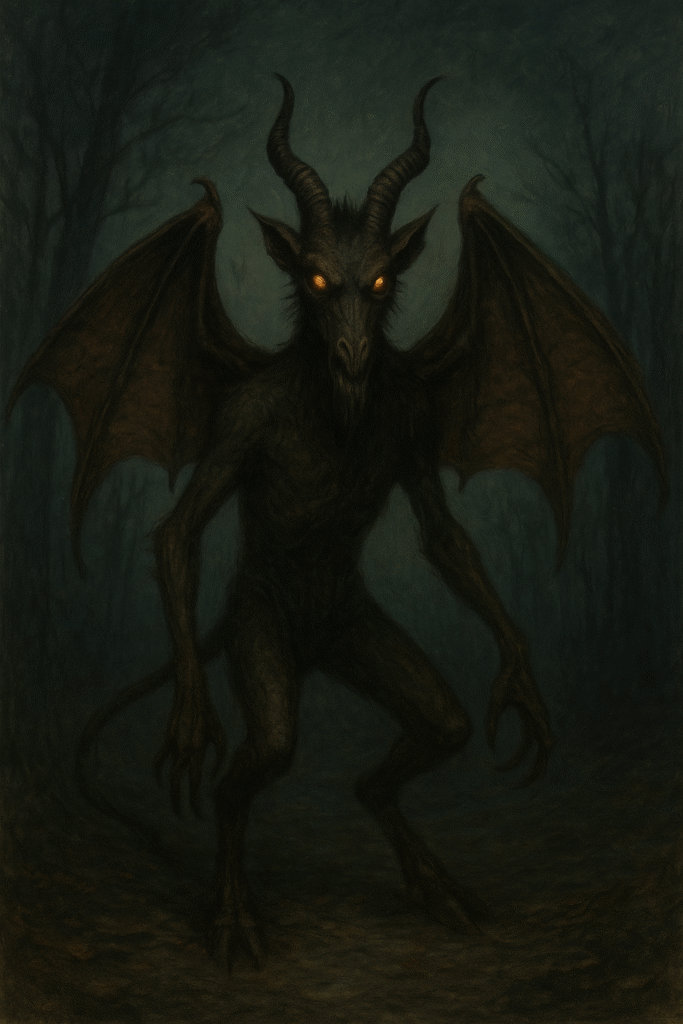
The old families of the Pinelands whisper of a creature with leathery wings, a gaunt body, a long horse-like face, and glowing red eyes that move between the branches like embers drifting on the wind. They call it the Leeds Devil, the cursed thirteenth child of a colonial mother whose name still survives in historical records.
Others claim it predates the colonial period entirely — a thing the forest hid long before settlers built their first homes.
Whatever its origin, the Jersey Devil has haunted the region for nearly 300 years, bridging folklore, documented sightings, newspaper accounts, and the collective dread of those who live near the woods.
This page explores its true origins, its physical form, its behavior, its historical sightings, and the uneasy place it still holds in New Jersey’s identity.
Origins — Cursed Child or Ancient Creature?
The Leeds Family Legend (1735)
The most widely cited origin story appears in colonial records and newspaper retellings dating back to the 18th century.
In 1735, a woman named Deborah Leeds — whose name appears in actual New Jersey genealogical documents — discovered she was pregnant with her thirteenth child. Exhausted, overwhelmed, and impoverished, she reacted in despair.
According to legend, she cried out:
“Let this one be the devil.”
When the baby was born at the Leeds homestead in the Pine Barrens, the midwives swore it changed shape before their eyes:
- Legs fused and twisted into hooves
- Skin stretched thin
- Wings burst from its shoulder blades
- Its cry warped into a tortured screech
The creature attacked everyone within reach, then flew up the chimney and vanished into the trees.
This is the traditional birth of the Jersey Devil — a story retold for centuries in newspapers, almanacs, and oral history.
The Leeds Name in Real History
The Leeds family was real.
Their patriarch, Daniel Leeds, published almanacs that angered local Quaker communities.
His symbols — especially a dragon-like figure on his family crest — were widely circulated and sometimes mocked.
The political conflict between the Leeds family and the Quakers helped the “Leeds Devil” nickname spread through the region long before the creature itself became a monster legend.
Folklorists believe this may have laid the groundwork for transforming a family feud into a supernatural entity.
Pre-Colonial and Early Settler Roots
Long before the Leeds family lived in the Barrens, indigenous Lenape people warned settlers about:
- “Night flyers”
- Winged spirits
- Forest protectors that shrieked in the dark
These beings were not described as horse-like, but they reinforced the idea that the woods held things humans were not meant to confront.
Many folklorists argue that the Jersey Devil is a merging of:
- Indigenous warnings
- Colonial fears
- Family conflicts
- Environmental isolation
- And centuries of evolving retellings
The Pine Barrens as a Cradle
The Barrens are vast — over a million acres — filled with marshland, thick woods, abandoned villages, and miles of unlit roads.
To many, it feels like the perfect place for a creature with wings to hide.
Appearance — The Devil of the Pines
Descriptions have remained remarkably consistent over the centuries.
General Features
The Jersey Devil is said to possess:
- A long, narrow, horse-like head
- Red, glowing, deeply set eyes
- A thin, elongated neck
- A gaunt, emaciated torso
- Two clawed forelimbs
- Two hind legs ending in cloven hooves
- Large, bat-like, leathery wings
- A long, whip-like tail
Skin tones reportedly range from pale gray to ashen brown.
When grounded, it stands roughly 3 to 5 feet tall, though height varies with posture.
Movement
Witnesses describe its motion as:
- Fast, erratic gliding
- Sudden dives toward livestock
- Perching high in trees
- “Hopping” or bouncing when on the ground
- Climbing like a large bat or malformed deer
Its wingspan is often described as 6–8 feet, large enough to cast a shadow across dirt roads.
The Eyes
The eyes are the most universally feared feature:
Not bright. Not fiery.
But glowing inward, like embers smoldering behind glass.
People claim the creature stares without blinking, as though it recognizes what it sees.
Behavior — Silent Wings, Shrill Cries
Nocturnal Activity
The Jersey Devil moves through the Barrens almost exclusively at night.
It avoids populated areas but appears near:
- Livestock pens
- Lonely cabins
- Marsh paths
- Abandoned mill towns
- Forest roads without lighting
Signs It Is Near
Those who live in the Barrens speak of warning signs:
- Crickets and birds abruptly stopping
- Hoofprints on rooftops or in snow with no approach tracks
- Branches broken high above human reach
- A foul, sulfuric or wet-musk odor
- Shrill, piercing cries that fade without echo
Its Cry
Descriptions of the Jersey Devil’s cry are consistent across centuries:
- High-pitched
- Throaty
- Metallic at the edges
- Somewhere between a scream and a whistle
Witnesses say the cry feels like something trying to imitate human anguish.
Diet and Habits
Folklore associates it with:
- Killing livestock
- Hunting small animals
- Attacking pets
- Surveying territory from treetops
It rarely confronts humans directly, though many report being watched from the shadows.
Territorial Nature
The creature seems to prefer:
- Cedar swamps
- Marshlands
- Deep pine groves
- Ruins of old colonial towns like Ong’s Hat, Martha’s Furnace, and Speedwell
Some say it circles an area for nights before moving on, leaving the forest unusually quiet in its wake.
Regional Variants — The Devil in Many Forms
Though consistent, reports fall into three main interpretations:
The Classic Leeds Devil
- Most human-like
- Horse head
- Hooves
- Deep historical roots
- Emphasis on the curse narrative
The Winged Cryptid
- More animalistic
- Stronger bat features
- Less tied to folklore, more to sightings
- Popular in modern eyewitness accounts
The Forest Watcher
- Seen motionless in treetops
- Wings folded, eyes visible
- Silent presence rather than aerial terror
All variations carry the same silhouette — something unnatural and unmistakable.
Cultural Significance — New Jersey’s Shadow
The Jersey Devil is woven into the identity of the Pine Barrens and the state itself.
It symbolizes:
- Colonial fear of isolation
- Religious superstition
- Conflict between settlers and nature
- Family scandal and reputation
- The unknown that survives in the wild
Its image appears in:
- Newspapers (since the 1800s)
- Eyewitness accounts (thousands over 300 years)
- Modern news reports
- Local festivals
- NJ sports teams (New Jersey Devils hockey team)
- Horror literature and documentaries
The creature is not just a legend — it is an institution.
People in New Jersey may not all believe in it.
But everyone knows you don’t mock it lightly inside the Barrens at night.
Conclusion
The Jersey Devil remains one of America’s oldest and most enduring cryptids — a creature born of curses, forests, colonial history, and the collective imagination of generations who lived too close to the dark.
People fear it because:
- It moves without a sound
- It cries like something half-human
- It leaves marks no animal should
- It watches from treetops most humans never look up to check
- It belongs to a forest too large to search and too old to fully understand
The Pine Barrens remain vast, untouched, and silent under the weight of stories whispered across centuries.
And somewhere above those endless pines, wings still beat against the night — unseen, unchallenged, and unforgotten.
When the forest falls quiet, when fog thickens across the road, and when a single shrill cry slices the silence…
you’ll know you’ve stepped into the territory of the Jersey Devil.
And the Barrens never give up what they decide to keep.