
The Chupacabra — The Goat-Sucker
Quick Facts
Region: Puerto Rico, Mexico, Southern United States, Latin America
Also Known As: El Chupacabras, Goat-Sucker
Classification: Blood-feeding cryptid / livestock predator
Primary Origin: 1990s Puerto Rico livestock incidents
Typical Behavior: Drains livestock of blood; nocturnal attacks; leaves small, circular wounds
First Signs: Sudden livestock death; little visible blood; puncture marks; disturbed pens; dogs refusing to approach
Weakness (traditional): Bright light, noise, elevated or reinforced pens
Introduction — A Harvest in the Dark
The night in the countryside is rarely silent.
There are insects, distant dogs, the shifting of animals in their pens. But every so often, the darkness changes. The air grows heavier. The usual sounds fade, replaced by a tense quiet that presses against the skin.
Farmers describe this moment the same way across countries:
“It felt like the night was holding its breath.”
Then comes the chaos—short, frantic, and brutally fast.
Goats bleat once, chickens flutter loudly, and dogs stop barking altogether. By the time anyone reaches the livestock pen, the noise is over. The ground is undisturbed. The animals lie where they fell.
No flesh torn.
No organs missing.
Just bodies that look emptied, as if something took only what it came for.
Two or three circular puncture wounds mark the neck or chest.
The rest is left untouched.
People have given many explanations for this pattern—wild dogs, disease, superstition. But across Puerto Rico, Mexico, Chile, Texas, and beyond, one name has become the symbol of these silent harvests:
Chupacabra — the Goat-Sucker.
Unlike ancient folklore spirits rooted in centuries of tradition, the Chupacabra is a creature forged in the modern era—built from fear, media, and the eeriness of unexplained livestock deaths. It is not a ghost. It is not a demon. It is something that feels animal, yet behaves with an unsettling precision.
This bestiary entry explores its origins, its possible forms, its behaviors, and why the legend refuses to die even after decades of debate.
Origins — A Modern Myth with Older Shadows
The Chupacabra’s most famous rise began in the mid-1990s in Puerto Rico, when farmers across small rural towns discovered livestock dead under mysterious circumstances. The bodies showed:
- No signs of struggle
- Clean puncture wounds
- Reports of decreased or missing blood
The pattern repeated often enough that communities believed a new predator had emerged—one not recognized by hunters or experts.
Naming the Unknown
The name El Chupacabras caught fire quickly. News reports and radio shows needed a label, and the term spread from town to town. Soon every unexplained livestock death across the Caribbean and Latin America found its way under the same umbrella.
But many folklorists think the concept may have existed long before the name became popular. Rural stories from earlier decades describe:
- “Nocturnal blood-drinkers”
- “Vampiro del campo” (vampire of the farm)
- Strange animals seen near dead goats
Though not identical, these older tales formed a fertile foundation for the Chupacabra to take root.
A Creature of Fear, Not of History
Unlike the Pontianak, the Wendigo, or other ancient beings, the Chupacabra is not tied to religious rites, ancestral myths, or rituals.
It is tied to fear of losing livelihood.
In many rural areas, a single dead goat is a financial wound.
Ten dead goats is devastation.
The Chupacabra became the name people gave to that nightmare.
Appearance — The Two Faces of the Chupacabra
The Chupacabra is unusual among monsters because it does not have a single, unified appearance. Instead, two major forms dominate witness descriptions. The creature seems to shift depending on region, environment, and culture.
Both forms share a sense of wrongness—something familiar altered into something predatory.
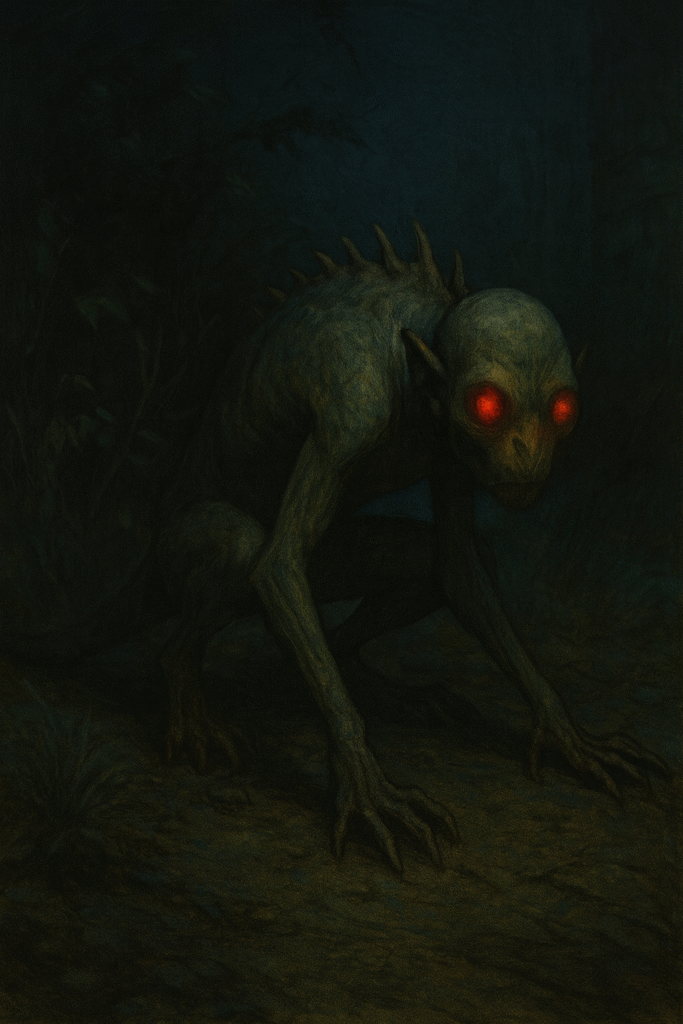
The Reptilian / Alien Variant
This is the version most associated with Puerto Rico and early Latin American reports. It is considered the “classic” Chupacabra in global media.
Typical descriptions include:
- Height: 3–4 feet (0.9–1.2 m)
- Posture: Bipedal or semi-upright; capable of hopping or leaping
- Skin: Gray, greenish, or leathery; sometimes scaled
- Back: A line of sharp dorsal spines running from neck to tail
- Eyes: Large, rounded, reflective; glowing red or orange in the dark
- Mouth: Small but with sharp, precise teeth
- Limbs: Long claws; thin limbs; unusual proportion
Witnesses describe it as a creature that moves with deliberate, almost thoughtful silence—observing before acting.
Some claim its eyes shine before its body is visible, as if it is watching from the edges of the pen.
This variation feels alien—something not of this world.
The Canine Variant
More common in Mexico, Texas, and the southern United States, this version leans toward an animalistic predator with unnatural features.
Common traits:
- Appearance: Hairless or nearly hairless
- Skin: Thickened, blue-gray or mottled
- Build: Gaunt, with ribs and spine sharply visible
- Face: Long snout with exposed teeth; sunken or glassy eyes
- Movement: Quick, low, and eerily quiet; able to jump fences
While some believe this is simply a mutated or diseased canine, witnesses consistently report that the creature behaves in ways no dog or coyote normally would.
It may pace back and forth before attacking
—
or stand perfectly still as if calculating.
This version feels like a corrupted predator—something familiar twisted into something else.
Common Features Shared Across Forms
Regardless of version, nearly all sightings agree on:
- A preference for livestock over wild prey
- Bright eyeshine at night
- An ability to move silently
- A sharp, musky odor
- A tendency to appear during droughts or food shortages
- A sense of “intelligence,” as if it chooses targets deliberately
Most importantly:
It does not feed like a normal predator.
It does not tear limbs or scatter feathers.
It takes only blood.
Behavior — The Signature of a Blood-Feeder
Nocturnal Movements
The Chupacabra operates almost exclusively after midnight. Night gives it cover—both from humans and from natural predators. Livestock tend to be resting, making attacks efficient and swift.
The Kill Pattern
The Chupacabra’s attacks follow a distinctive pattern that sets it apart from wolves, coyotes, or feral dogs:
- One or several animals dead in the pen
- Bodies intact, lying close to where they slept
- Two or three small puncture wounds
- Very little visible blood
- No dragged carcasses
- No obvious struggle
Farmers often describe it as if the animals simply collapsed.
Avoidance of Humans
Despite its frightening reputation, the Chupacabra rarely shows interest in humans. It avoids light and noise, slipping into shadowed corners and fences where visibility is low.
Dogs sometimes refuse to confront it—whining, hiding, or backing away from the pen.
Territorial Yet Mobile
The creature appears in clusters. A region may experience multiple attacks over a week, and then activity stops entirely as if the predator moved on.
This mobility contributes to the sense that the Chupacabra is not tied to one habitat.
Intelligent Feeding
Witnesses say it:
- Chooses the smallest or most vulnerable animals
- Works quickly
- Does not waste energy
- Leaves predators confused, not terrified
The Chupacabra does not kill for brutality.
It kills with purpose.
Abilities — Ascribed in Folklore
Silent Approach
Farmers often report that they heard nothing—not even dogs barking. This suggests heightened stealth or an ability to move without startling animals until the moment of attack.
Fence Leaping
Numerous regional stories describe the creature clearing wire fences and low walls effortlessly.
Low-Light Vision
Nearly all sightings at night involve glowing red or orange eyes, suggesting exceptional night vision or reflective retinal tissue.
Precise Feeding
The creature’s most iconic trait: extracting blood through small, clean wounds. Some accounts describe the marks as circular or needle-like.
Persistence
Once it finds a food source, it often returns until interrupted or frightened off.
Regional Variants — A Continent-Wide Phenomenon
Puerto Rico
- Reptilian/alien variant most common
- Origin point of the modern legend
- Livestock deaths reported across multiple towns
Mexico & Central America
- Both variants appear
- Often layered with beliefs in witches, nocturnal spirits, or rural curses
Texas & Southern United States
- Dog-like, hairless variant most common
- Seen frequently near farms during drought seasons
- Sometimes captured on game cameras
Chile, Brazil, Argentina, and Beyond
- The name “Chupacabra” becomes an explanation for unexplained livestock deaths
- The creature becomes a symbol of rural mystery across borders
Cultural Significance — A Modern Monster for Modern Fears
The Chupacabra stands apart from ancient monsters because it represents something deeply modern:
- Fear of economic loss
- Fear of unseen threats
- Distrust in institutions and official explanations
- The rapid spread of stories across global media
- The blending of folklore, rumor, and real farm devastation
It is a creature of transition—born at the moment when rural tradition collided with mass communication.
It spread faster than any folklore before it because it was carried not by wandering storytellers, but by:
- Radio shows
- Newspapers
- Early websites
- Internet forums
- Television specials
In a sense, the Chupacabra grew alongside the digital age. It became one of the first “globalized cryptids,” recognized everywhere despite being tied to local tragedies.
It embodies the anxiety of waking up and discovering that something you depend on—your animals, your stability—has been taken without warning.
Conclusion
The Chupacabra remains one of the most enduring creatures of modern folklore.
Not ancient.
Not mythic.
But no less terrifying.
People fear it because:
- It kills with unnatural precision
- It moves without sound
- It leaves bodies intact but empty
- It targets livelihood—not life
- It appears suddenly and vanishes just as quickly
Whether it is:
- A rare predator,
- A misidentified animal,
- A mutated species,
- Or something stranger that walks the line between legend and reality,
the Chupacabra continues to haunt rural landscapes and internet discussions alike.
Its story is carried not by old rituals but by modern ones:
- Flashlights sweeping dark fields
- Farmers whispering to neighbors
- Reporters searching for answers
- Communities naming the thing they fear
The Chupacabra’s true power is not in its teeth, but in its mystery.
It exists in every quiet night where livestock pens sit under the moon, and in every morning when the farmer walks out hoping the count hasn’t changed.
Because once the word “Chupacabra” enters a region’s vocabulary, every dead goat becomes a question.
And every shadow becomes a possibility.