
The Dybbuk Box — Spirit Without Rest
Quick Facts
Region of Origin: Jewish communities in Eastern Europe (notably Poland and Lithuania)
Also Known As: Dibbuk Box, HaKufsa HaMe’ureret, The Spirit Cabinet
Classification: Cursed object / Spirit prison / Occult reliquary
Primary Origin: Jewish mysticism — specifically Kabbalah and folklore surrounding possession
Typical Behavior: Inflicts nightmares, induces dread, attracts vermin, causes misfortune
First Signs: Foul odors, electronic interference, shadow sightings, persistent whispers
Weakness (traditional): Ritual cleansing, Hebrew incantations, burial in consecrated ground
Introduction — A Box That Should Never Be Opened
Its wood creaks without movement. The air grows still when it enters a room. Owners speak of a constant weight, not of the box itself — but of what surrounds it. A heaviness that pulls at the soul.
The Dybbuk Box is not merely haunted. It is inhabited.
Within its sealed frame, bound by wine-stained wood and ancient prayers, lurks a restless force — a dybbuk — a malicious spirit from Jewish folklore, said to cling to the living when denied its passage to the afterlife.
Unlike most cursed items, the Dybbuk Box does not crave freedom.
It wants you — your attention, your fear, your voice in the dead of night whispering, “Is someone there?”
It answers.
Origins — Where the Living and the Dead Cross Paths
The box’s recorded history is murky, littered with disputed claims, mysterious disappearances, and fractured family accounts.
Three major origin stories compete — all of them horrifying:
The Holocaust Survivor’s Box
The most circulated account ties the box to Havela, a Polish Jewish woman who survived the Holocaust. According to a handwritten letter discovered alongside the box, Havela used Kabbalistic rituals to trap a dybbuk — a parasitic soul — within the wine cabinet after it tormented her and others during wartime.
She instructed her family never to open it and never to sell it.
Yet decades later, it was purchased at a yard sale in Oregon.
The box was opened. The nightmares began again.
The Ritual Gone Wrong
Some occult researchers believe the box was created during a failed ritual — a misguided attempt to capture a dybbuk for study, profit, or revenge. The spirit, however, was too strong.
It lashed out, killing the medium and infecting the box with its wrath.
It was then hidden, passed from hand to hand, always with one instruction:
“Do not open.”
The Inherited Curse
In this version, the box was never created, only found. It drifted through generations of Jewish families, its origins forgotten but its effects devastating — miscarriages, psychosis, disease, broken homes. Some claim it predates the written record, carried through whispered lineage and locked behind prayer and oak.
The Dybbuk — Spirit Without Rest
In Jewish folklore, a dybbuk (from the Hebrew dāḇaq, “to cling”) is the dislocated soul of a deceased person, usually malevolent, that attaches itself to the living.
But this is no Hollywood demon.
The dybbuk is deeply personal.
It knows your regrets. Your losses.
It whispers in your voice… about things only you remember.
In mystic tradition, it enters through the cracks — emotional, spiritual, even physical. Some say a dybbuk is not merely a ghost… but a mirror of the worst in ourselves, given form.
The Dybbuk Box, then, is no containment.
It is bait.
A trap that draws the curious, the grief-stricken, the broken — and offers a promise:
“I can help you forget.”
But the price… is everything.
Contents — More Than What’s Inside
The original Dybbuk Box was reported to contain:
- Two locks of hair (one blond, one dark)
- A small granite slab inscribed with the word “Shalom”
- A dried rosebud
- A goblet
- A candlestick holder
- A wine cup
- Two 1920s pennies
Each item is thought to be symbolic: offerings, anchors, or bindings — traditional elements used to weigh down spirits in ritual magic.
However, attempts to remove these items often result in worsened activity: sudden illnesses, car accidents, even death.
It’s not what the box contains…
…but what contains the box.
Appearance
Witnesses consistently describe:
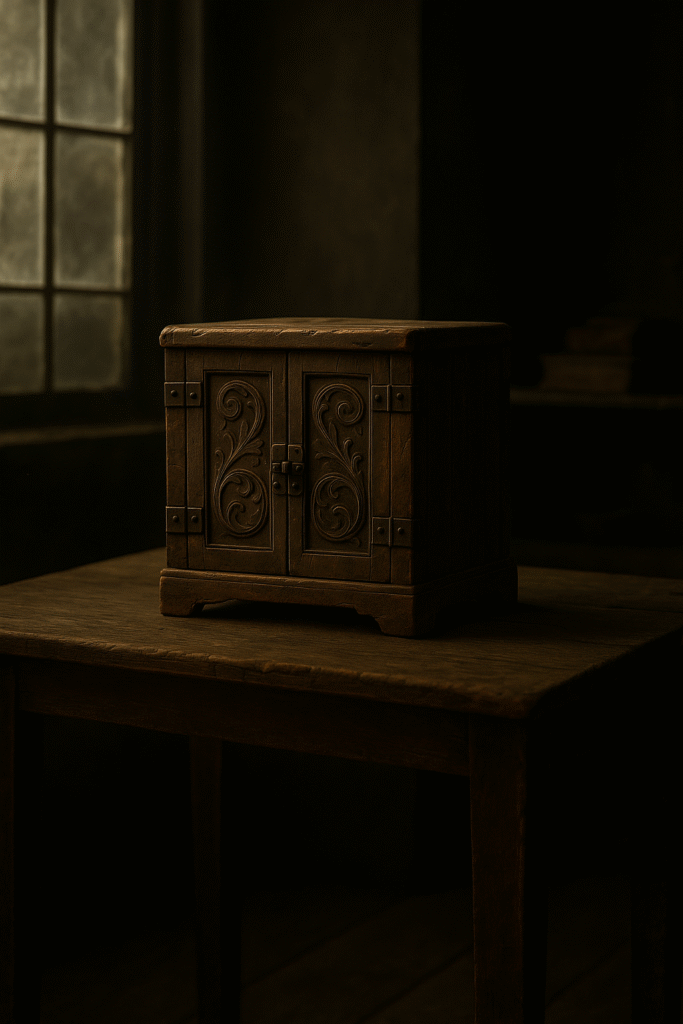
- A wooden wine cabinet with twin doors and a drawer beneath
- Ornate carvings, sometimes forming Hebrew letters or protective sigils
- A musty, acrid odor — likened to urine, decaying flowers, or ammonia
- A coldness that radiates from the wood even in warm rooms
- A sense of being watched when nearby
The box is deceptively small — yet those who carry it say it feels heavier than it should, as if the air around it resists motion.
Photographs of the box often appear distorted. Blurry. Faces warped.
Some claim the box affects digital media — corrupting files, draining batteries, disabling electronics.
Behavior — Whispers in the Dark
The Dybbuk Box is not passive.
It chooses its moments.
And when it does… nothing remains the same.
Initial Symptoms
- Frequent nightmares
- Electrical malfunctions
- Sudden insect infestations (especially moths and spiders)
- Objects falling or shattering inexplicably
- Feelings of intense dread at night
Escalation
- Visual apparitions: shadow figures near the box
- Foul odors that move from room to room
- Sleep paralysis
- Physical marks — scratches, bruises — with no explanation
- Voices mimicking family members
Final Phase
- Mental breakdowns
- Psychosis
- Self-harm or suicide attempts
- Pets avoiding the area or acting violently
- Compulsion to open the box again
Those who have tried to destroy it report accidents immediately after:
Car crashes. Fires. Hospitalizations.
It does not want to be harmed.
It only wants to be remembered.
Notable Manifestations
Kevin Mannis, 2001
The first public account of the Dybbuk Box comes from Portland, Oregon.
Mannis, a writer and antique dealer, purchased the box at an estate sale.
Within days:
- His mother suffered a stroke after opening the box
- Lights shattered
- Nightmares plagued every owner
- All attempted resales were accompanied by warnings:
“If you buy this box, may God have mercy on your soul.”
Post–eBay Ownership
The box passed through several owners, each reporting intensified hauntings.
One, a museum curator, developed a chronic illness.
Another experienced complete memory loss during ownership.
The box now resides in a private paranormal museum — behind glass, salt, and prayer.
Still, visitors report unease. Some faint. Others vomit.
Phones die. Watches stop.
It is contained.
But never dormant.
Modern Encounters & Cultural Legacy
The Dybbuk Box has become a cultural phenomenon — featured in films, documentaries, and web series.
But its curse spreads digitally too.
Reddit threads detailing experiences often go silent without warning.
YouTubers claiming the box is fake report accidents weeks later.
One debunker mysteriously vanished from social media entirely.
His last post read:
“I shouldn’t have opened it. It’s not empty.”
Some claim the box does not need to be physically present.
Reading about it.
Speaking its name.
Even thinking of opening it may be enough to invite attention.
The Dybbuk…
…listens.
Abilities
- Nightmare Induction — Recurring dreams of fire, screaming, or graves
- Electromagnetic Disruption — Kills electronics within proximity
- Auditory Manipulation — Whispers, mimicry, and disembodied voices
- Psychic Attachment — Follows specific individuals across homes
- Insect Manifestation — Attracts moths, cockroaches, spiders
- Illusion Weaving — Causes hallucinations and false memories
- Dream Infiltration — Victims claim the Dybbuk speaks in dreams
- Mental Manipulation — Depression, anxiety, obsession with the box
- Temporal Bleed — Hours vanish without memory or explanation
Protection & Weakness
No method is guaranteed. But folklore recommends:
Weaknesses:
- Salt rings and iron shavings
- Hebrew exorcism rites
- Burial in a clay jar in sacred ground
- Burning sage and myrrh (ineffective alone)
- Avoidance of naming the spirit aloud
Safeguards:
- Never open the box
- Do not mock or challenge the spirit
- Keep the box in total darkness
- Avoid sleep after exposure
- Limit attention — the more you fear it, the stronger it becomes
Some say the only true protection is ignorance.
But you’ve read this far, haven’t you?
Conclusion — The Spirit Waits
The Dybbuk Box is more than a relic.
It is a ritual object, a container of sorrow, and a magnet for fear.
It feeds on attention, spreads through belief, and survives through story.
Whether the box houses one dybbuk or many, one truth remains:
Every retelling, every post, every whispered “Did you hear about it?”
makes it stronger.
If you see a small wine cabinet for sale…
If it smells like death…
If it feels heavier than it should…
Don’t open it. Don’t even touch it.
Because the moment you bring it into your home…
…it brings something else into you.
And it never leaves.