
CASE FILE #004 — THE WOMAN IN THE SNOW
Quick Facts
Region: Japan — most common in snowy mountain regions (Niigata, Nagano, Tohoku, Hokkaido)
Also Known As: Snow Woman, Yukijorō, Yuki-musume
Classification: Ice Spirit / Death Entity
Primary Origin: Pre-Shinto animism; later yokai tradition
Typical Behavior: Appears during winter storms, lures or freezes victims
First Signs: Sudden silence, drifting white figure, frost gathering indoors
Traditional Weakness: Warmth, companionship, long-kept promises
Introduction
Winter in Japan carries a silence unlike any other — a soft smothering hush that seems to swallow thought and distance.
Travelers tell of nights when the road vanishes beneath sudden snowfall, and the world folds into white emptiness.
Even now, villagers say that if you hear nothing in a storm — not wind, not birds, not your own footsteps — you should turn back immediately, for you are no longer walking alone.
She is out there.
The Yuki-Onna appears when the world is quietest.
A pale woman drifting through snowbanks, her skin white as frost, her breath colder than death itself.
Some say her beauty is so startling that victims follow her willingly, smiling even as their blood freezes still.
Others describe her as sorrowful, helping lost travelers find their way home, only to disappear before they can thank her.
Her nature shifts between mercy and cold hunger, like winter itself — capable of nurturing life but equally capable of extinguishing it.
This case file gathers the stories that remain.
Though scattered across centuries, they share a chilling truth:
If she finds you, your fate will depend not on strength but on the warmth you hold within.
Origins — Born From Snow, Fueled by Breath
No one agrees on how the Yuki-Onna first came to be.
Some legends claim she was once a human woman lost in a blizzard and frozen to death, her spirit rising to wander forever in the storm that killed her.
Others say she is older than humanity — a manifestation of winter itself, the icy breath of mountains given form.
In certain regions, she is remembered not as a killer but as a guardian.
In the days before temples, villagers believed that winter spirits balanced life and death.
They could bring heavy snow to punish greed or light snow to replenish water come spring.
Yuki-Onna was neither villain nor saint — merely a force of nature with a woman’s face.
Later stories describe her as a woman who died during childbirth in a snowstorm — her grief binding her to the world.
Some say she wanders searching for her lost child, sometimes seen carrying a swaddled bundle of ice.
Those who approach to help find nothing in her arms… nothing but frozen breath.
Her identity remains uncertain.
Only her presence is sure.
Appearance — The Beautiful Death
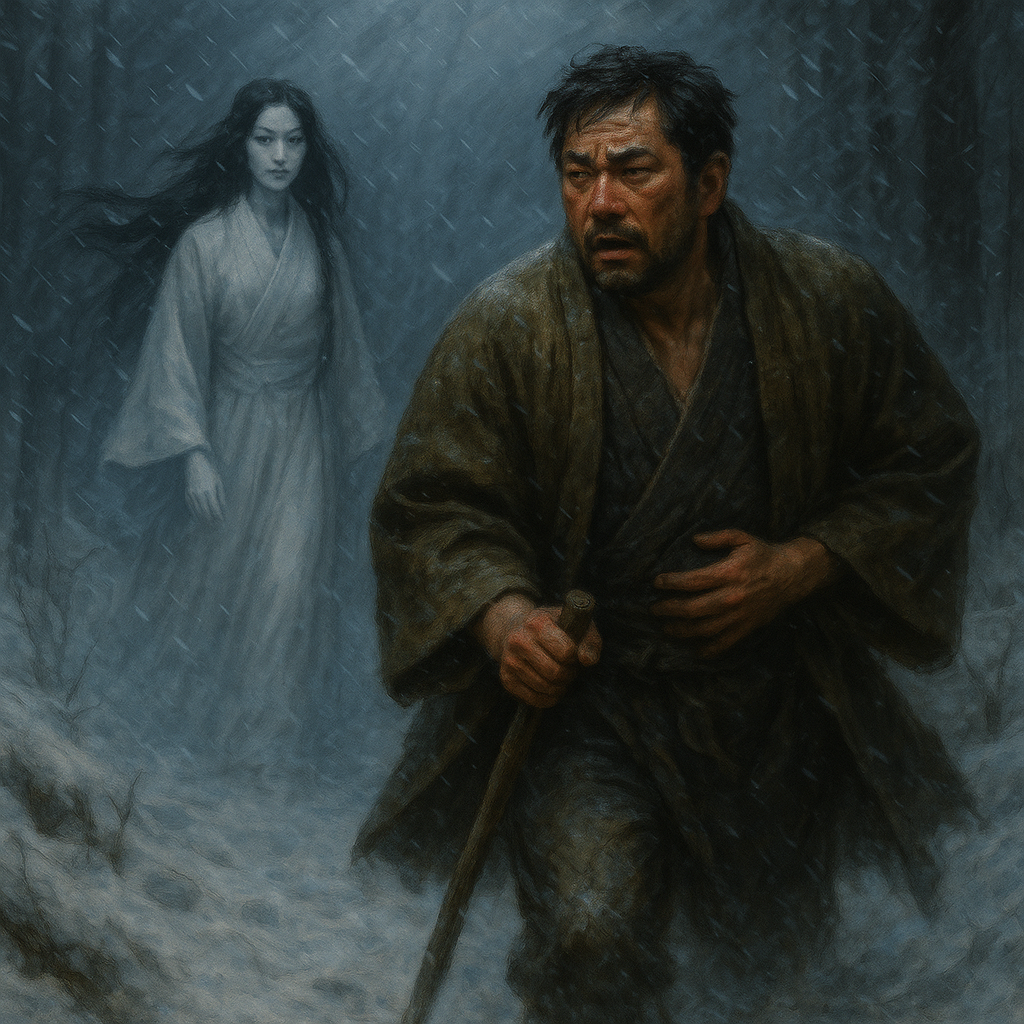
Witnesses call her breathtaking — a woman so pale and still she seems carved from the winter sky.
Her long hair drifts like fresh snow moving in a wind no one feels.
She wears a white kimono that blends seamlessly with the night, making it impossible to tell where cloth ends and storm begins.
Her feet never sink into drifts.
She leaves no mark behind — no footprint, no shadow, only the memory of cold.
Her eyes are the most terrifying.
They shine with quiet melancholy, yet something ancient lurks beneath, watching without mercy or warmth.
Those who meet her gaze often lose the will to flee — not hypnotized, but strangely at peace, as though surrender is the only sensible answer.
In rare tales, her kimono is tinged blue as though soaked in moonlight.
More disturbing stories describe her appearing nude, her skin glassy and translucent, veins visible like cracks in ice.
On nights when she is displeased, her beauty distorts.
Her mouth widens, teeth sharp as icicles, frost pouring from her breath.
Victims freeze before they can scream.
Behavior — Between Hunger and Mercy
Yuki-Onna is drawn to travelers caught in sudden storms — particularly those who linger at mountain borders or forest paths after sunset.
She is also known to appear outside homes during deep winter nights, a pale silhouette peering through windows as if deciding whether to knock.
Her behavior is unpredictable.
Sometimes she kills instantly, placing cold lips to a traveler’s mouthand inhaling their life in a single breath.
Other times she walks silently beside them, never speaking, never touching, simply watching as their strength fades from cold alone.
Some she leads off the road entirely, their footprints vanishing mid-snow.
But other stories tell of compassion.
A lost child, found at dawn beside a shrine, unharmed — claiming a beautiful lady carried him to safety.
A hunter, rescued from frostbite, later seeing the same pale woman standing at the edge of the woods, smiling faintly before fading into falling snow.
Those spared by her often live quietly afterward, haunted not by fear but by longing — as though part of them remains wandering with her.
No tale suggests she acts without reason.
Winter chooses its victims and its survivors.
So does she.
Encounters — Stories That Never Melt
The Woodcutter’s Secret — Niigata, 1737
A blizzard trapped two men in the mountains.
Through the storm, a pale woman appeared, breath clouding the air around her.
She froze the younger man with a sigh and turned to the elder.
“If you speak of me,” she warned,
“I will return.”
The man later married a quiet, beautiful woman who never seemed to age.
Years passed.
One winter night, he told her the story of the storm, thinking it harmless at last.
She grew still.
Her eyes filled with ancient sorrow.
“You promised.”
She dissolved into snow before his eyes.
Their children found only frost on the floor.
Lantern on the Road — Nagano, 1891
A merchant heading home noticed a woman standing beneath a stone lantern.
Her hair was long, her kimono white as drifted snow.
She followed without sound, floating just above the road.
When he began to chant sutras, she stopped and faded into mist.
The next morning, the lantern stone was found cracked by frost though the night had been only mildly cold.
Sleeping Breath — Akita, 1955
During a harsh winter, children of a village began disappearing.
One boy was later found unconscious in the forest, clothes dusted with snow despite no footprints around him.
When he awoke, he spoke only of a beautiful lady who asked if he was lonely.
He said her touch felt warm — yet frostbite claimed his fingers.
The Tunnel Sight — 1928
Rail workers clearing snow from a mountain tunnel reported seeing a woman standing on a ledge, staring down at them.
Her presence unnerved them just moments before an avalanche struck the exact spot where they had been removing ice.
Some believed she tried to warn them.
Others believed she meant to bury them.
No one returned to that site alone.
The Wedding Night — Hokkaido, 2016
A man lost during a snowstorm claimed he saw a barefoot woman walking ahead of him.
She turned and smiled, telling him to follow.
He refused, terrified by how her breath made no fog in the air.
The next day, he was found alive, surrounded by melted snow in a perfect circle.
Survivors say she spared him but marked him.
Years later, on his wedding night, he was found frozen in bed, expression peaceful — as though dreaming of someone just beyond the veil.
Patterns & Notes
Victims often report feeling unusually calm before they die.
Her presence seems to bleed warmth from the soul before the body notices.
Dogs howl before she arrives and flee into hiding.
Homes where she has stood feel colder for days afterward, even in rooms without open windows.
In almost every case, snowfall increases sharply during or after the encounter — as if the sky follows her.
Nature & Meaning
Yuki-Onna is winter manifested — beautiful, lethal, indifferent.
She is neither demon nor protector, but something between.
Some who survived her say she carries deep sadness, as if bound to the cold against her will.
Others claim she is drawn to spirits that flicker brightly — a candle offered willingly to the storm.
There is no record of her ever attacking during summer.
Her world is frozen time and moonlit quiet.
A lesson is often attached to her stories:
Don’t travel alone at night.
Don’t open your door to strangers.
Don’t tell secrets that aren’t yours.
Winter listens.
Methods of Protection
Villagers once placed warm offerings outside their doors — sake, rice, glowing candles — not to banish her but to appease her.
Fire and companionship are cited as the strongest protection; those who walk together rarely see her.
Those who survive alone are considered chosen — spared for reasons unknown.
Why She Lives On
Yuki-Onna remains because winter still kills.
Snow still descends suddenly, silencing roads, stealing travelers without ever revealing how.
Her image lingers in art, literature, modern film and manga — but the old fear remains intact.
Some say the moment you begin to see beauty in a winter storm is the moment you are closest to her.
For beauty is the most dangerous when it offers peace in a place you should never rest.
Conclusion
A hush spreads across the snowfield.
Footsteps slow.
The wind stops breathing.
You feel warmth leave your limbs one note at a time.
Through the drifting white a figure appears — hair as black as the void, skin luminous as ice, eyes deeper than night.
She does not speak.
She does not need to.
Her hand lifts softly, palm open, inviting.
You know that if you take it, the cold will feel like sleep, and sleep will feel like home.
Somewhere beneath the snow your breath continues to float — waiting for spring that will never come.
And on the mountain road, your footprints end mid-stride, melting slowly into the drifting white.