
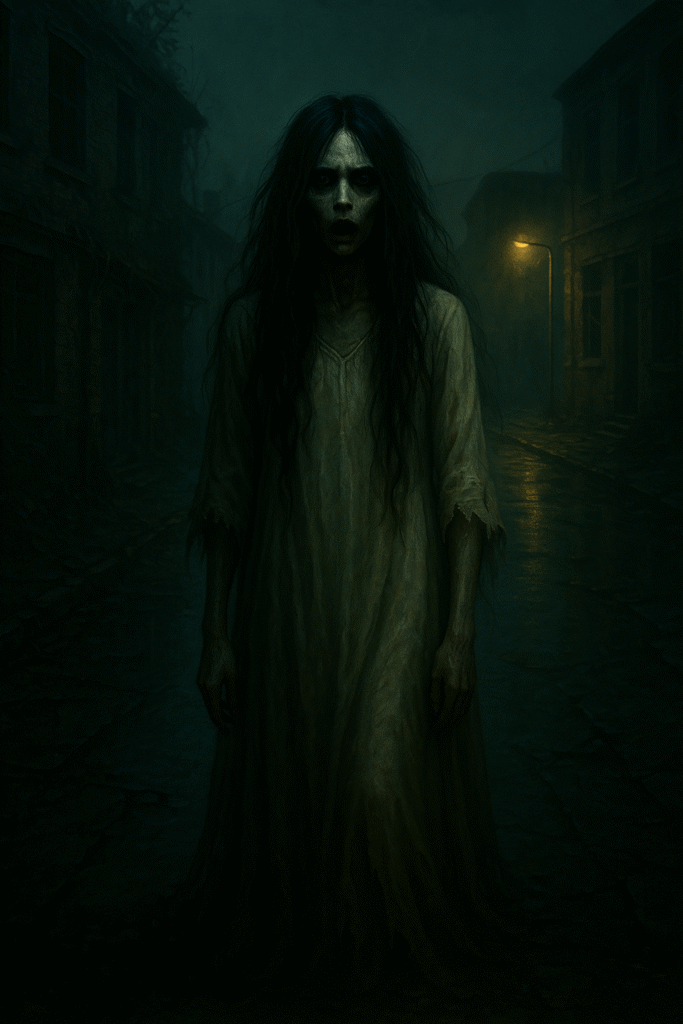
The Pontianak – The Scent of Death in Bloom
Locals whisper that if the night wind carries the scent of frangipani when no flowers are around, you must not follow it. You must not even look behind you. Because the one who brings that fragrance is not of this world.
They call her Pontianak — the restless spirit of a woman who died while carrying child. Her rage and sorrow bind her to the mortal realm, cursed to wander between life and death.
Under the pale moonlight, she appears as a beautiful woman — long black hair cascading down her shoulders, her white gown swaying like mist in the dark. But beauty is a mask, and the mask never lasts long.
Those who have seen her true face speak of hollow eyes and a mouth torn wider than humanly possible. Her nails grow like daggers, and her cry pierces the night — half wail, half shriek — echoing through jungles, rice fields, and forgotten streets where no one should walk alone.
Old hunters claim she lingers near banana trees or riverbanks, where the air grows still and the wind seems to vanish. Some say she waits for men who stray too far from home, calling out in a soft, melodic voice — the voice of a lover, a mother, or a friend long lost. When the fool turns to answer, all that follows is silence… then blood.
Her arrival is not always heralded by sound. Sometimes, the only warning is that scent — sweet, floral, deceiving — and the sudden chill that makes your skin crawl.
To see her is to be marked. To hear her laughter is to know your death is near.
There are those who believe that if you nail a steel spike to her neck, she becomes human again — trapped in flesh, robbed of her power. But no one who’s ever tried has lived long enough to prove it.
“If the wind carries the scent of flowers where none grow,” an old tracker once said, “don’t breathe. Don’t look. Don’t listen. Just run.”
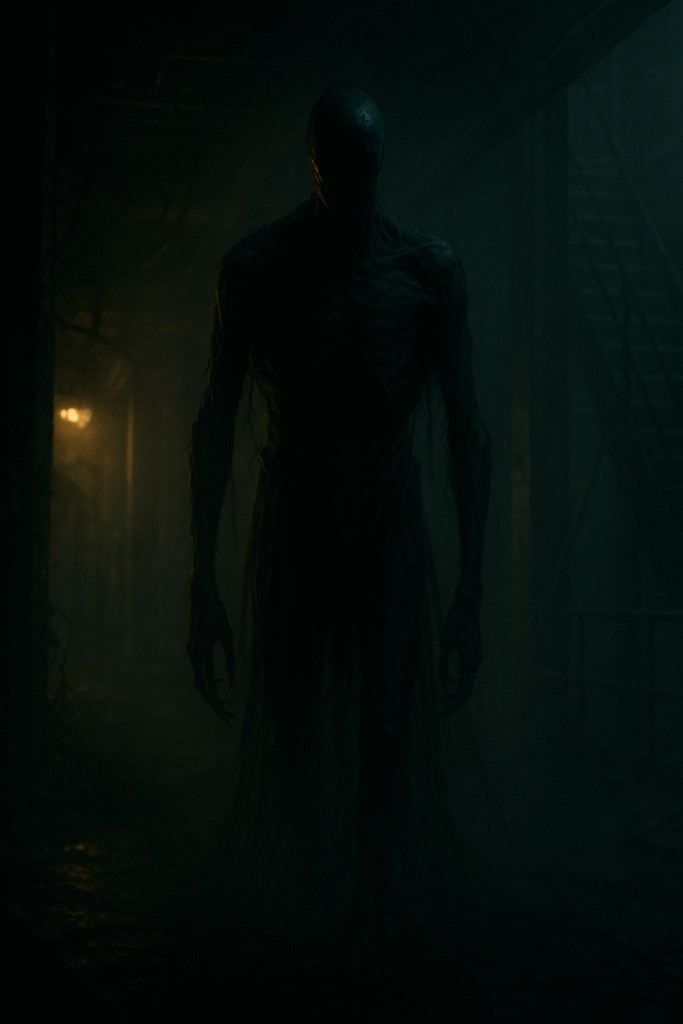
The Hollow Man — A Presence That Erases
They say the Hollow Man is not a ghost, not a monster, not even alive — just what’s left when a man’s soul forgets its shape.
No face. No eyes. Only the outline of what once was, swallowed by shadow and silence.
Witnesses describe him as a figure standing where no one should — at the far end of a hallway, on the edge of a clearing, just barely visible through the fog. His body moves like smoke learning to walk again, and the air bends around him as if refusing to remember he’s there.
He never speaks. He never runs. He simply watches. And the longer you stare back, the harder it becomes to remember your own face.
Some believe he was born from guilt — a man who couldn’t live with what he had done, whose body remained but whose reflection was erased. Others claim he is an echo, a living shadow that feeds on recognition — that the moment you notice him, you become part of his emptiness.
“He doesn’t hunt. He waits. You fill in the shape — and that’s how he becomes you.”
Old hunters warn that mirrors, windows, and still water can summon him.
If your reflection doesn’t blink when you do — run.
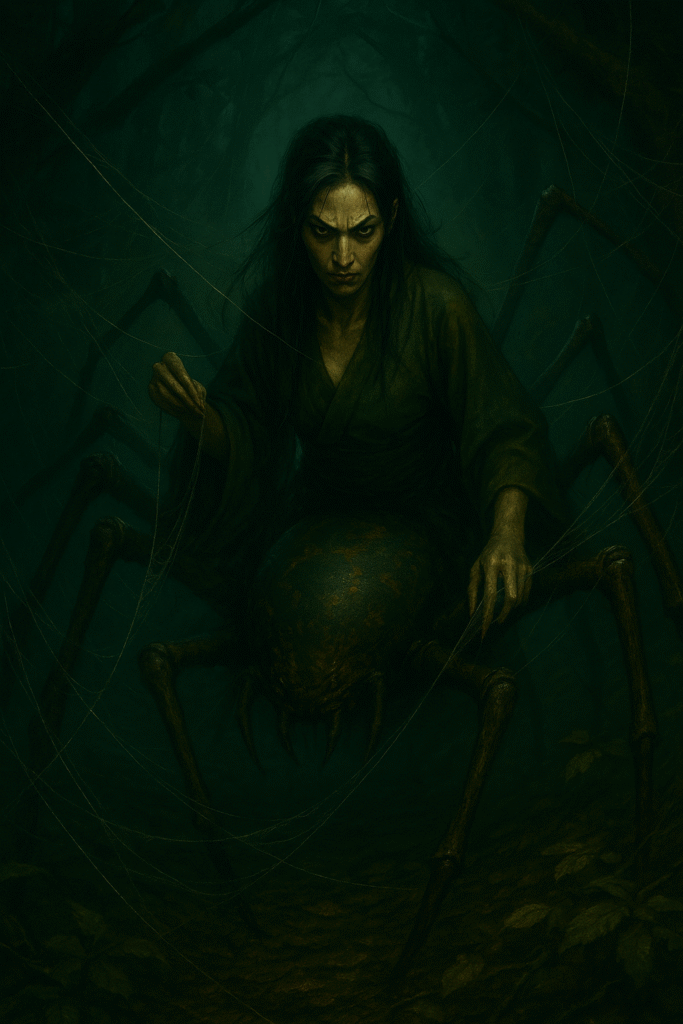
Jorōgumo — The Weaver of Gentle Death
In the lantern glow of forgotten mountain villages, there are stories of a woman whose beauty stops travelers dead in their tracks.
Her voice soft as rain. Her eyes kind — almost too kind. And when she smiles, it feels like coming home.
But if you listen carefully, you’ll hear another sound beneath her words — the faint, rhythmic click of spider legs moving in the dark.
They call her Jorōgumo, the Binding Bride. A predator older than the written word, wrapped in silk and skin. By day she walks as a woman of impossible grace, and by night she reveals what the world was never meant to see — a creature whose elegance hides a web that glows like moonlight on water.
Some claim she chooses her prey out of loneliness. Others say she feeds not on flesh but on attention itself — every glance, every heartbeat, every breath stolen by her beauty adds another thread to her web. Those who see her true form say she moves with the patience of eternity — neither rushing nor hesitating — as if she’s known for centuries how every story ends.
“The Jorōgumo doesn’t hunt,” an old hunter once wrote. “She invites. You walk willingly into her web because she makes you believe it’s love.”
When morning comes, her victims are found entombed in silk — still smiling, as if dreaming of her touch.
If you ever meet a woman by the riverside whose reflection ripples like eight limbs beneath the water, don’t follow her home.
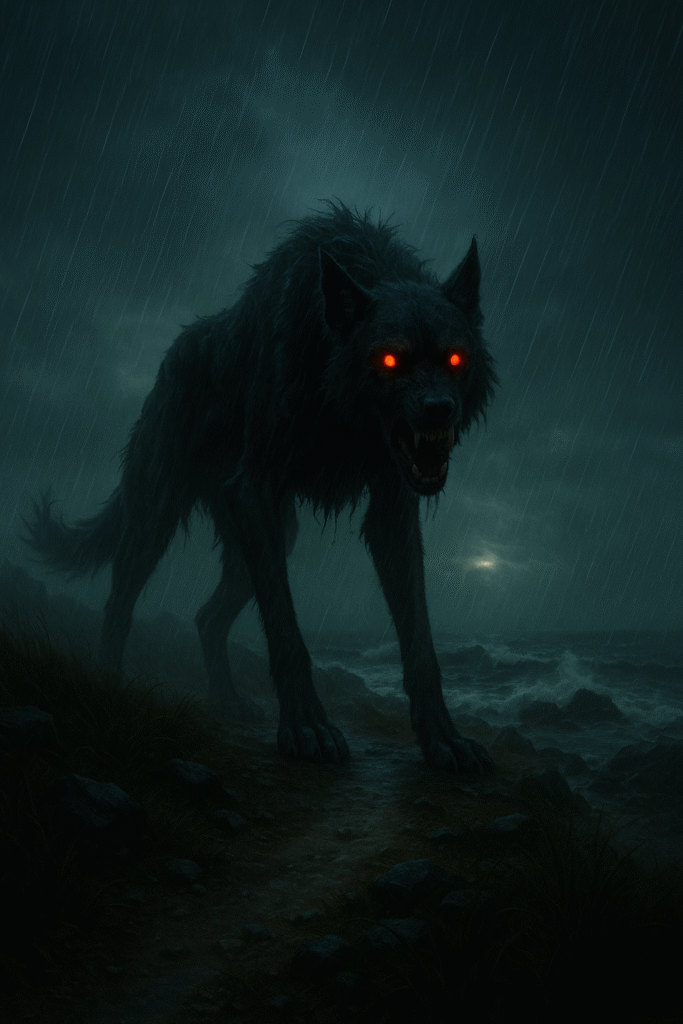
The Black Shuck — The Hell Hound of the English Coast
There are nights when the wind howls so loud that it drowns out the sea. And yet, beneath the roar of thunder and the hiss of rain, you might still hear something else — the sound of paws on wet stone.
They call it the Black Shuck — a hound as old as the fog that rolls in from the sea, its eyes burning red through the storm.
Fishermen say it follows ships from the cliffs. Travelers swear it appears on coastal roads when lightning splits the sky. Some say it’s death itself, others say it’s what hunts death.
Those who’ve seen it claim it doesn’t bark or growl. It just watches. Silent. Massive. Steam rising from its fur as if the storm itself breathes through it. The air grows heavier in its presence, the world smaller — as if the night bends to make room for it.
Legends say the Black Shuck appears to those marked for death. But there are stories of those who stood their ground — who looked into those eyes and lived to tell the tale. They describe something ancient, sorrowful… and bound. A creature chained to the storm, cursed to walk until the last wave drowns the coast.
“The Shuck isn’t chasing you,” one hunter wrote. “It’s leading you somewhere. You just won’t like where.”
Locals still whisper that if the thunder quiets suddenly and the wind stops — it’s already there, watching from the mist.
And when it finally passes, the world never feels quite as alive again.
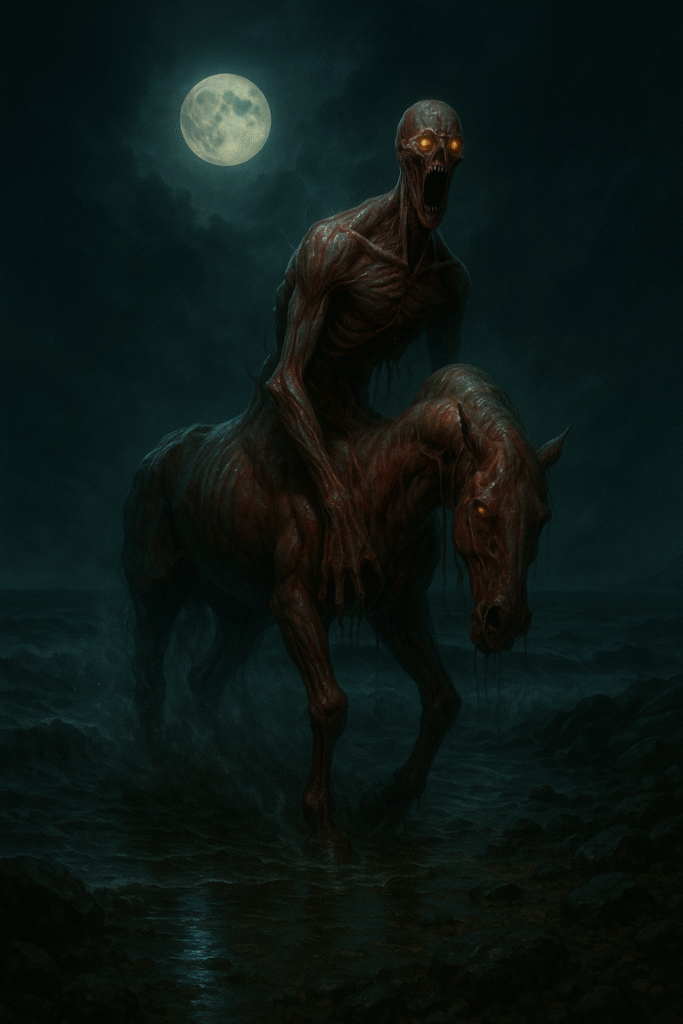
The Nuckelavee – The Skinless Rider of the Tides
The sea remembers what man has forgotten. Every storm it swallows, every life it drags beneath the black waves, becomes part of something older — and crueler. When the mist rolls in thick and the tide retreats too far, fishermen say the Nuckelavee walks again.
No skin sheaths its form. The creature glistens red, raw, and pulsing — veins black as kelp writhing beneath the surface of its flesh. The horse and rider are not two beings but one — fused in a grotesque mockery of life, as if the ocean itself tried to sculpt a god from corpses and failed. The rider’s arms are too long, dragging through the surf as the beast lumbers forward. Its breath smells of rot and brine. Where it walks, grass turns to ash and wells sour with salt.
Old sailors speak of seeing it rise from the foam during the blackest nights — when the wind dies and the sea goes still. Its arrival heralds plague, famine, and death, carried in the stench of decay and salt that clings to every shore it haunts. Those who stare too long swear they can hear it whisper, its voice like boiling water and tearing flesh.
There is no stopping it, only appeasing it. The islanders once burned offerings of barley to keep it away, but those rituals have long been forgotten — and so the Nuckelavee walks again, seeking the warmth of the living to mock what it will never have.
If you see the tide glowing faintly red under the moon, do not look closer.
For beneath the waves, something skinless stirs.
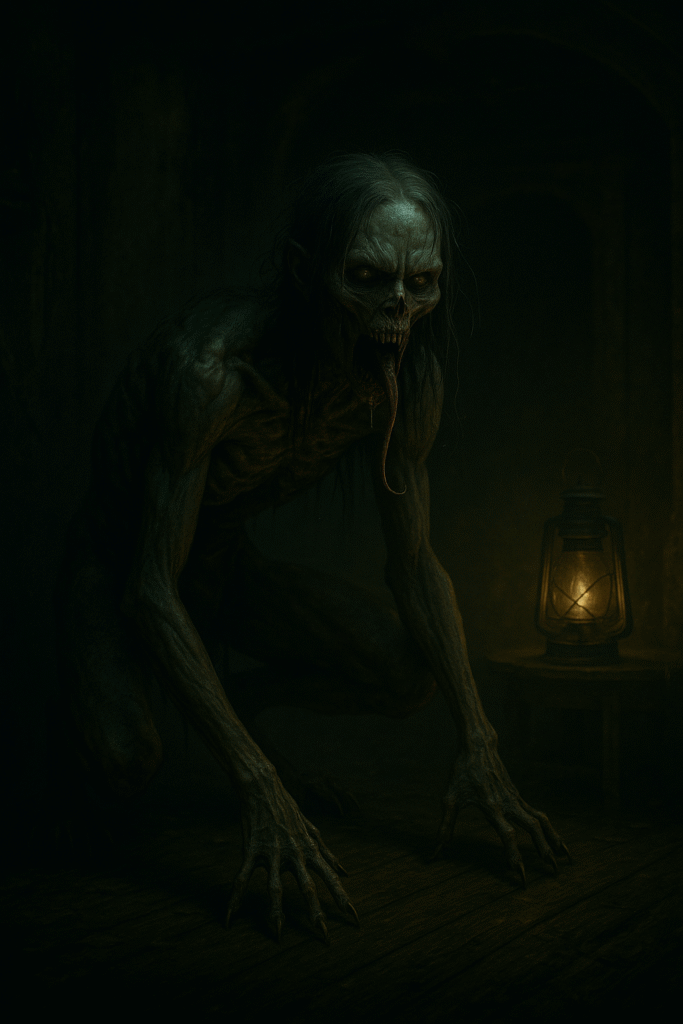
The Aswang – The Hunger That Wears a Face
There are nights in the provinces when the air feels heavy — as if the trees themselves are holding their breath.
Banana leaves hang still, dogs whimper under the stilted huts, and not even the crickets dare to sing. The old folks say that’s when the Aswang is near.
By day, she is no different from anyone else. She smiles at the market. She laughs over gossip. She sells fruit with hands that still smell faintly of blood. You would never suspect her. You’d even greet her on your way home, not realizing that when the sun falls, her smile will be the last familiar thing you ever see.
When hunger calls, her bones rearrange with the sound of snapping twigs. Her spine lengthens, her neck twists, and her skin begins to peel — not off, but open, as if her body remembers something older than human. Wings like torn leather bloom from her back, stretching wide enough to swallow the moonlight. Her reflection vanishes, her heartbeat stops, and what remains is a silhouette with eyes that burn faintly red, like dying embers watching from the dark.
She hunts in silence. Her tongue, long and pointed like a spear, slips through cracks in the floorboards, tasting the air for the scent of life — a mother’s breath, a child’s heartbeat, a sleeping soul that won’t wake. Her hunger is patient, methodical. You will not hear her land. You will not see her shadow. You will only feel the weight of something above your roof… listening.
The old hunters say her cry changes depending on how close she is — louder when she’s far, faint when she’s near. But no one who has heard it fade to a whisper has ever lived to confirm it. They claim she drinks not only blood, but the soul itself, leaving her victims pale, hollow, and twisted — like wax figures left too close to a flame.
Some say the Aswang was once human — cursed by betrayal, starvation, or grief. Others whisper that she was never human at all, only pretending to be. Every province has its version. Every family has its story. But all share the same warning: never travel alone after midnight.
And if you ever see a figure crouched by the road, feasting on something you can’t quite make out — do not look closer.
Because the moment she notices you watching… she will smile.
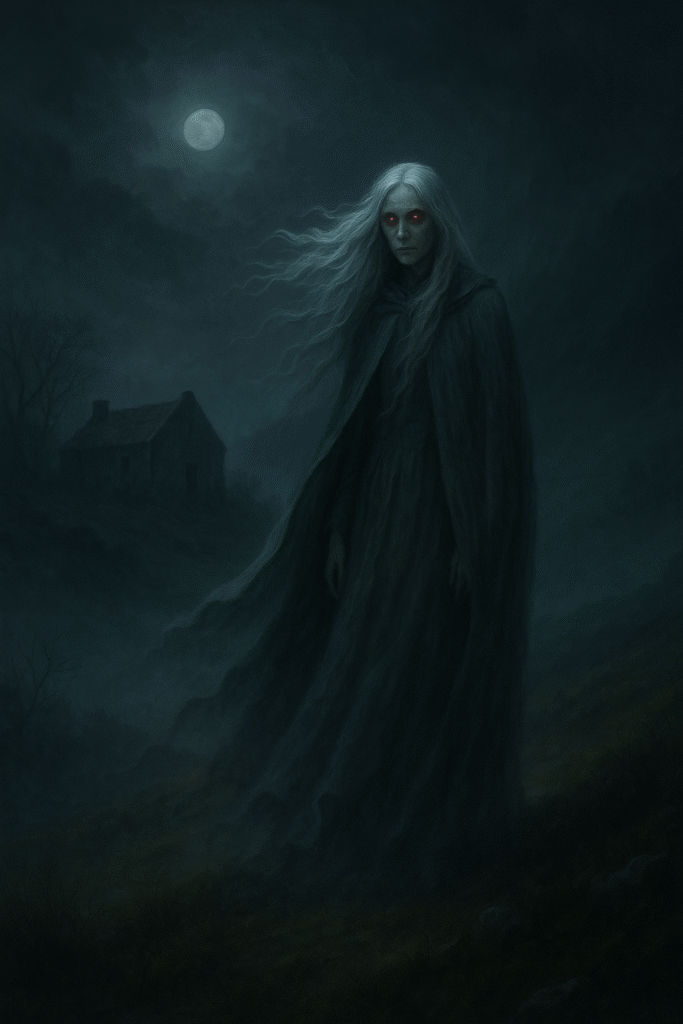
The Banshee – Wail of the Coming Death
There are nights in the countryside when the fog settles too thick, too low — as if the hills themselves are bracing for something.
Lanterns flicker without wind, cattle refuse to leave their pens, and even the ravens keep silent along the stone walls.
The old families say that’s when the Banshee is near.
By day, the world looks ordinary. The hearth is warm, the farmhands laugh, and the house smells of bread and peat smoke.
You would never sense anything amiss.
You would never suspect that someone in the home has already been marked — that a fate has been sealed quietly, long before anyone realized it.
And when dusk settles, the first sound you hear may not be thunder, or wind, or rain…
but weeping.
When sorrow calls, she appears where grief has not yet begun. A figure drifting along the hedges, silver hair trailing like mist behind her. Her cloak clings to her shape without touching it, as though she is only half-present in this world.
Her eyes glow faintly red, not with rage, but with mourning too old for words.
She raises her head, opens a mouth that never moves, and what follows is not a scream — but a long, hollow wail, stretched across the hills like the earth itself is crying.
She mourns in silence between breaths, moving from window to window, searching for the soul she has come to lament.
Her presence chills the rooms she passes. Candles gutter. Dogs crawl beneath tables and refuse to look toward the door.
Her keening is patient, measured.
You will not hear footsteps. You will not feel her enter.
You will only hear the weight of sorrow gathering outside your walls… listening.
The old families say her cry changes depending on whose time is nearly done — soft for the very old, sharp for the very young. But no one who has heard the final note has ever been able to describe it.
They claim she does not take life, only announces its ending.
Yet those who listen too closely feel their strength fade, their thoughts dim, as if her grief brushes against the edges of their soul and carries a piece of it away.
Some say the Banshee was once a mortal woman — a mother who died waiting for a child who never returned, or a lover who perished with her final words unsaid.
Others whisper she was never alive at all, but born from the ancient mounds, a spirit woven from Ireland’s oldest tragedies.
Every valley has its tale. Every bloodline has its omen.
But all share the same truth: when the Banshee cries, someone is already halfway to the grave.
And if you ever hear a woman sobbing outside your window when no one should be there — do not look out.
Because the moment the crying stops…
she is already close enough to see your breath.
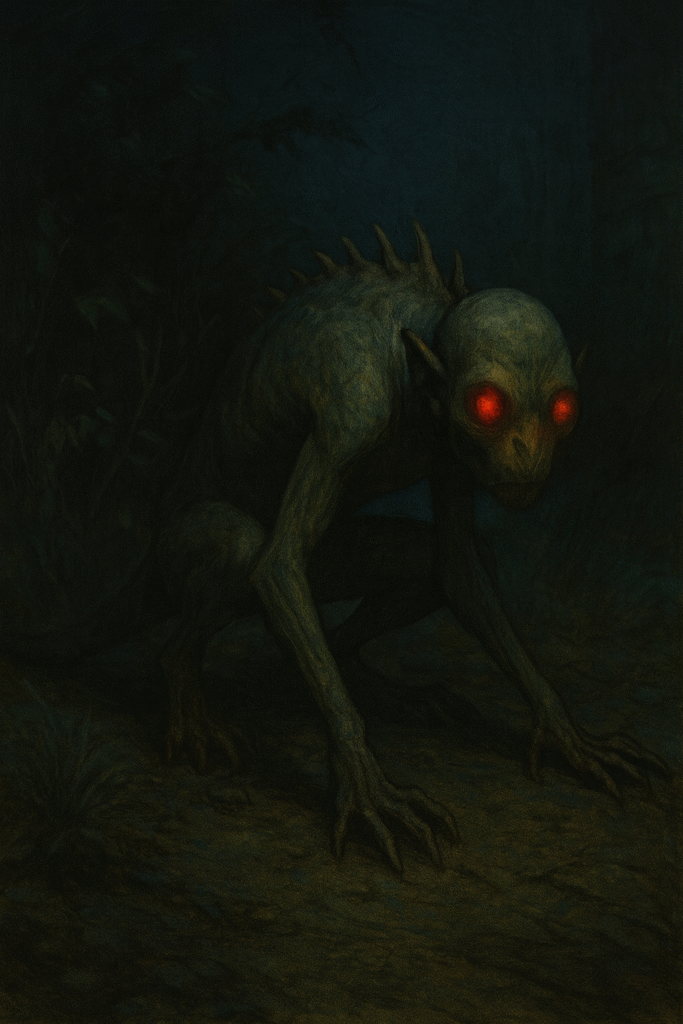
The Chupacabra – The Goat-Sucker
There are nights in the countryside when the animals sense something long before the humans do — when goats grow uneasy, chickens stop their murmuring, and the dogs refuse to step off the porch.
Old farmers say that’s when the Chupacabra is near.
By day the fields look safe enough. Nothing hints that something has already studied the pens, watched the routines, and waited for darkness to settle.
But when the night arrives, the first warning is silence — a heavy, unnatural stillness where even the wind seems to hide.
Then it moves.
Some describe it as reptilian with gray skin and spines along its back. Others swear it’s a gaunt, hairless beast with eyes that shine like embers. The shapes differ, but every account shares one truth:
It does not kill like an animal.
It kills with intention.
The creature slips into the pen without a sound. The livestock panic only for a moment before going still. There is no chase, no tearing of flesh — just two or three small puncture wounds and bodies left unnervingly intact.
By dawn, the ground is undisturbed. No blood. No struggle. Only the unmistakable sense that something took exactly what it came for.
People say the Chupacabra returns to the same farm for nights in a row, testing gates, stalking shadows, learning the patterns of the living. Some claim it sees perfectly in the dark. Others whisper it can slip through gaps no creature its size should pass.
Whether it is a twisted predator, an old thing that once haunted the forests, or something stranger caught between worlds, the legend stays the same:
When the animals fall silent, the Chupacabra is already close — close enough to choose its next breath, its next body, its next hunger.
And if you step outside to investigate…
you might discover it doesn’t mind taking more than goats.
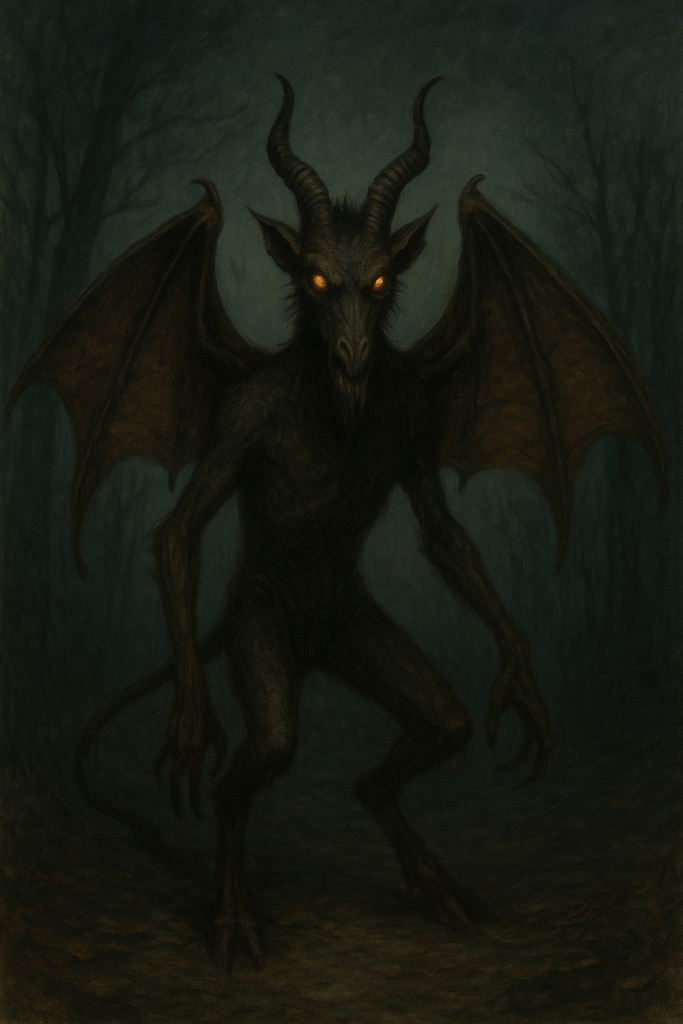
The Jersey Devil — The Haunt of the Pine Barrens
There are nights in the Pine Barrens when the forest feels too still — when the pines stand like watchmen, the marsh fog creeps low across the dirt roads, and every sound fades as if the woods are holding something back.
Locals say that’s when the Jersey Devil is near.
By day, the Barrens look ordinary. Sunlight cuts through the trees, sand paths wind between cabins, and everything feels almost peaceful.
But once night settles, the quiet becomes absolute.
Crickets stop.
Birds vanish.
And far above the treetops, something lets out a thin, twisting cry that doesn’t belong to any living creature.
Those who claim to have seen it describe a gaunt, winged figure — the body of a starving animal, leathery wings stretched too wide, long limbs ending in hooves, and eyes that burn red against the dark. It moves like something the forest itself wants to hide, slipping between branches with unnatural ease.
Some say it was born cursed — the thirteenth child of a woman named Leeds.
Others insist it was never human at all, only a thing the Barrens have sheltered for centuries.
Whatever the truth, its signs are always the same:
Hoofprints where no horse could climb.
Branches snapped high above eye level.
Shrieks drifting across empty roads.
A feeling, sharp and instinctive, that something is watching.
No one agrees on what it seeks.
Livestock?
Solitude?
Or the foolish traveler drawn too deep into the woods after dusk?
But everyone in New Jersey knows the same rule:
If you’re driving through the Barrens at night and the woods suddenly fall silent —
don’t stop.
Don’t check the trees.
Don’t follow the sound of wings above your car.
Because silence is the moment the Jersey Devil chooses to get close.
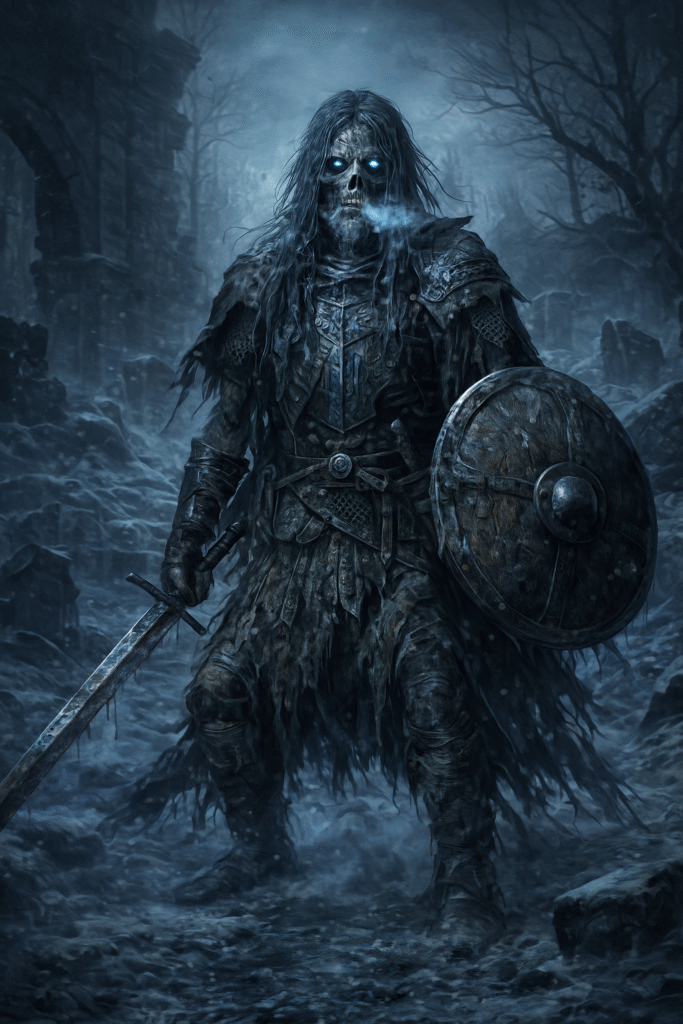
The Draugr – The Dead Who Refuse Their Grave
Locals across the frozen North say that if the night wind suddenly turns colder than the air around you — bitter, wet, like breath rising from the mouth of a corpse — you must leave the burial mounds at once.
Do not linger.
Do not touch the stones.
And above all, do not look back.
Because what rises from those graves is not a ghost.
It is something worse.
They call it the Draugr — the restless dead of Norse legend, a warrior too stubborn, too hateful, or too greedy to accept death. Its soul clings to its corpse like frost clings to bone, refusing to release what life has already taken.
Under the moonlight, the Draugr appears as a swollen, blackened thing — a corpse swollen with rage, its skin stretched tight over muscle that should not move, armor fused to decaying flesh. Its eyes shine like frozen embers, cold blue or dull red, glowing from deep inside the skull.
Those who have seen the dead rise from the mound speak of footsteps heavier than any living man, of doors ripped from their hinges, of livestock crushed beneath hands as strong as boulders. Its breath — foul, damp, corpse-cold — kills sheep outright and weakens any who inhale it.
Old sagas warn that the Draugr wanders far from its grave: stalking fjords, smashing barns, cursing families, and hunting those it hated in life. Sometimes it appears at the window of a lonely farmhouse, its glowing eyes watching from the dark until fear breaks the mind of whoever notices.
Its arrival is not always loud. Sometimes the only warning is the sudden silence — a stillness so deep even the wind seems to hide — followed by a single heavy footstep, slowly pressing the snow flat.
To see it is to face the fury of a man who refused the mercy of death.
To hear its groan is to know something has come looking for you.
Some believe that if you sever the Draugr’s head and burn what remains, the spirit is finally forced to leave the body. But few who confront the creature ever live long enough to try.
“If the wind grows colder near the mounds,” an old Icelandic shepherd once said, “don’t speak. Don’t breathe. Don’t think. Run. The dead are walking.”