
The Spear of Destiny — The Holy Lance That Pierced History
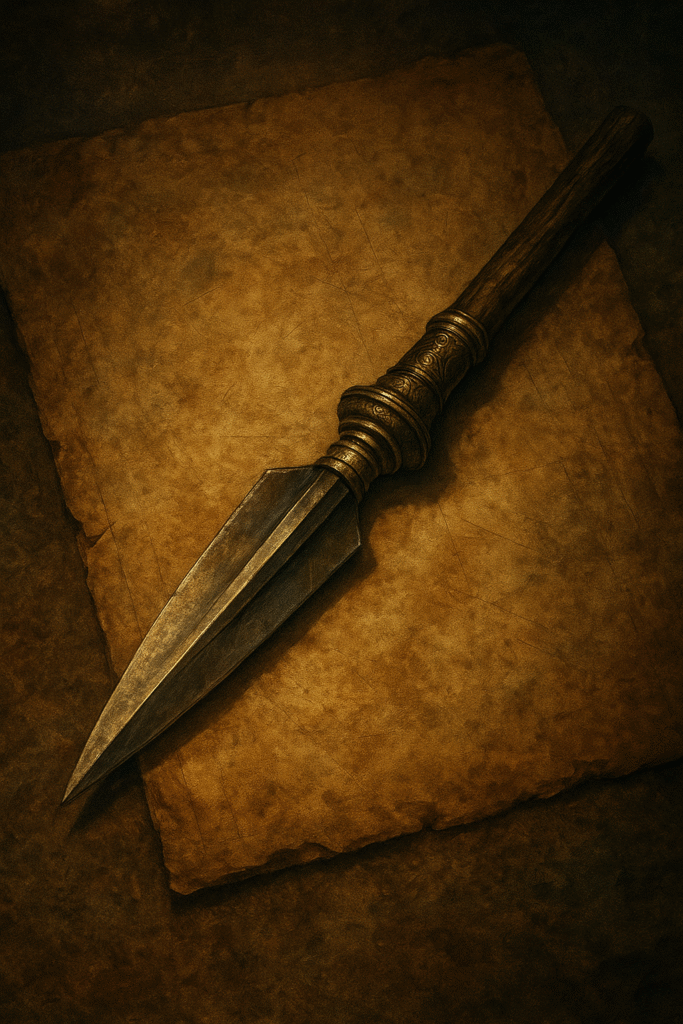
Quick Facts
Region: Judea (origin); venerated across Rome, Constantinople, the Holy Roman Empire, and modern Austria, Vatican City, and Armenia
Also Known As: Holy Lance, Lance of Longinus, Spear of Longinus, Lancea et Clavus Domini
Classification: Christian relic / imperial insignia / legendary talisman
First Appearance: Gospel account of the Crucifixion (1st century); relic traditions attested by late antiquity
Alleged Powers: Divine mandate to rule; invincibility in battle; protection of realms; catastrophic “loss-curse” for unworthy holders
Current Location (claimants): Imperial Treasury in Vienna; St. Peter’s Basilica (Vatican City); Mother See of Holy Etchmiadzin (Armenia)
Introduction — The Wound That Changed the World
A hill outside Jerusalem. A body on a cross. A Roman soldier steps forward, the sun fading to iron. The spear slides under the ribs—and blood and water flow. The act is simple, brutal, final. Yet from that stroke arises one of the most enduring legends in the West: the Spear of Destiny, the Holy Lance that touched the body of Christ and forever after was said to shape empires, crown kings, and doom the arrogant.
To the faithful, the lance is a relic of the Passion. To emperors, it was a scepter of providence. To storytellers and seekers, it is the sharp edge where history and myth meet.
Origins — Longinus and the Sign of Blood and Water
Christian tradition names the soldier Longinus, the centurion who pierced Christ’s side when the executioners saw He was already dead. The detail that “blood and water” flowed became theologically immense: blood for the Eucharist, water for Baptism—an image of the Church born from Christ’s side.
From the earliest centuries, pilgrims spoke of seeing a lance venerated in the Holy Land. Within generations, the lance was no longer just a weapon in a story; it was an instrument of the Passion, touched by the divine and carried across continents by bishops and emperors.
From Relic to Talisman — Early Legends and Miracles
As Christianity spread, so did the lance’s aura. Miracles were ascribed to it. Processions bore it like a royal standard. Over time, the name of Longinus fused with lore of healing and conversion, and the lance’s point became a sign of both judgment and mercy—the weapon of death that testifies to redemption.
By the medieval era, the Holy Lance was more than sacred metal. It was a mandate: proof that the bearer ruled under heaven’s gaze.
The Lance Through Empires
Constantinople — A Relic of the East
After upheavals in the Holy Land, a celebrated lance point was reported in Constantinople, displayed among the imperial relics. The city’s emperors, heirs to Rome, held the Passion instruments as tokens of divine favor.
Paris and Rome — Fragments in the West
Medieval transfers and gifts moved parts of the lance westward. A revered tip was treasured in Paris by the French crown, while a spearhead fragment reached Rome, where it remains associated with St. Peter’s Basilica. Even then, churchmen acknowledged competing claims and urged caution in declaring a single “true” lance.
The Holy Roman Empire — Scepter of the Kaisers
In the Latin West, a different lance rose to preeminence: the imperial lance long tied to St. Maurice and later identified as the Spear of Longinus. Medieval memory cast it through a royal lineage:
- Constantine: the first Christian emperor; legends link him to the lance’s power.
- Charlemagne: the Frankish king said never to have lost a battle while holding the lance.
- Otto I and the Ottonians: crowned with the lance at hand, showcasing imperial destiny.
- Frederick Barbarossa: the red-bearded emperor associated with cautionary tales—drop the lance, and doom follows.
For centuries the imperial lance traveled with the crown jewels of the Holy Roman Empire, eventually held by the Habsburgs and today displayed in Vienna’s Imperial Treasury.
The Crusader Lance of Antioch
During the First Crusade, when Crusaders were besieged and starving in Antioch, a visionary claimed revelation of the Holy Lance buried beneath a church. A point of iron was dramatically unearthed; morale surged; a desperate army charged—and won.
Skeptics later doubted the find, and the relic’s authenticity became contested. Some traditions connect a lance kept in Armenia to this episode. Whether miracle, mistake, or pious fraud, the Antioch lance shows how powerfully the Holy Lance could move men—belief itself becoming a weapon.
Disputed Versions — Vienna, Rome, Armenia
Centuries left multiple “Holy Lances”:
- Vienna (Hofburg): the best-known imperial lance, long part of the regalia; enhanced with a golden sleeve inscribed “Lance and Nail of the Lord,” as if enclosing a fragment of the True Cross nail. Many scholars date the blade’s manufacture to the early medieval period, with later sacred fittings.
- Vatican City (St. Peter’s): a spearhead fragment long displayed in Rome and linked to Constantinople’s relic stream; historically associated with a missing tip once kept in Paris.
- Echmiadzin, Armenia: a uniquely shaped spearhead revered by the Armenian Apostolic Church; tradition connects it to apostolic times, while others associate it with the Antioch discovery.
Authenticity remains unresolved. The Church has never issued a final pronouncement, and modern analyses often suggest medieval fabrication or refashioning around older elements. Yet the ambiguity fuels the legend: the real lance may be among them—or lost.
Powers and Perils — What the Spear Allegedly Does
Across chronicles and campfires, the Spear of Destiny is credited with:
- Divine Mandate & Kingship — legitimizing rule, embodying sacred authority
- Victory in Battle — conferring invincibility on righteous (or ruthless) wielders
- Protection of Realms — a sovereign’s pledge and talisman in one
- The Loss-Curse — mislay the lance, and fortune reverses: rulers fall, empires crack
Myth remembers a pattern: hold the spear and rise; lose it and fall. Whether theology or superstition, that rhythm became part of the lance’s thunder.
Nazis and the Spear of Destiny — Symbol, Myth, and Ruin
In the twentieth century, the Holy Lance slipped from reliquaries into propaganda.
- After the Anschluss, the imperial regalia—including the Vienna lance—were moved to Nuremberg, a Nazi “spiritual capital,” to bind the Third Reich to medieval imperial grandeur.
- Himmler’s SS indulged in mythic pageantry and relic-hunting; Wagner’s Grail lore and holy spear imagery saturated Nazi aesthetics.
- Postwar myths claimed Hitler pursued the spear for occult power and that its loss coincided with his end. Whatever one believes, the narrative stuck: a tyrant reached for holy thunder and found only silence.
When Allied forces seized Nuremberg’s hidden vaults in the war’s final days, the imperial treasures were recovered and returned to Vienna after the conflict. The spear’s modern chapter closes not with spells, but with a glass case.
Holy Lance vs. Spear of Longinus — What’s the Difference?
They are often used interchangeably:
- Holy Lance / Spear of Destiny — broad legendary name for the relic that pierced Christ.
- Spear (Lance) of Longinus — emphasizes the centurion’s traditional name and saintly legend.
- Imperial or St. Maurice’s Lance — the Western imperial insignia later identified with Longinus’s spear.
Different names reflect different traditions, but the mythic center is the same: a spear that touched the crucified Christ and crowns or curses those who claim it.
Symbolism — Theology, Empire, and the Bleeding Lance
The Holy Lance occupies a charged crossroads:
- Theological Symbol — Blood and water = sacraments and Church. The weapon of death becomes the sign of life.
- Sacral Kingship — From Constantine to Kaisers, rulers held the lance to stage divine right.
- The Bleeding Lance — In medieval romances and later opera, a perpetually bleeding spear mirrors a wounded land and king; only purity, compassion, and right order can heal it.
- Power and Hubris — The spear offers destiny—but warns of pride: those who grasp too tightly are cut.
Where Is the Spear of Destiny Now?
- Vienna, Austria — The imperial lance can be viewed in the Imperial Treasury (Hofburg).
- Vatican City — A revered spearhead fragment is associated with St. Peter’s Basilica.
- Echmiadzin, Armenia — The Mother See’s museum displays the Armenian lance to pilgrims.
Each is presented as part of Christian heritage. None is officially certified as the lance from Calvary.
Cultural Impact — From Reliquary to Reel
The Spear of Destiny thrives in modern imagination:
- Adventure & War Stories — Nazi heists, wartime vaults, and postwar hunts keep the spear in thriller DNA.
- Fantasy & Comics — From demon-fighting urban fantasy to alternate-history epics, the lance is a classic ultimate artifact: power at a price.
- Games — Castles, cathedrals, and final bosses—many a quest ends where a glowing spearhead waits.
It endures because it offers storytellers everything at once: sacred past, imperial pomp, apocalyptic stakes.
Historical Caution — What We Can (and Can’t) Claim
- Multiple Relics Exist. Each has deep tradition; none has definitive proof back to 1st-century Judea.
- Medieval Reworking Is Common. Many sacred items were refitted over time (golden sleeves, inscriptions, added fragments).
- Legend Shapes Memory. Battles won with the lance and rulers lost without it create a tidy pattern history rarely grants—yet that pattern is why the spear captivates.
Why the Legend Lives
Because it sits at history’s brightest flame—the Crucifixion—yet casts myth’s longest shadow. Because kings needed a sign, soldiers needed a banner, and people needed a story that made power accountable to the sacred. Because in every age someone believes destiny can be held—and learned from—before it cuts the hand that grasps it.
The Spear of Destiny isn’t simply an iron blade behind glass. It is the idea that authority must answer to mystery, that victory without virtue ends in ruin, and that a single act on a Judean hill can echo through palaces and battlefields for two thousand years.