
The Jade Death Mask — Face of the Eternal Kings
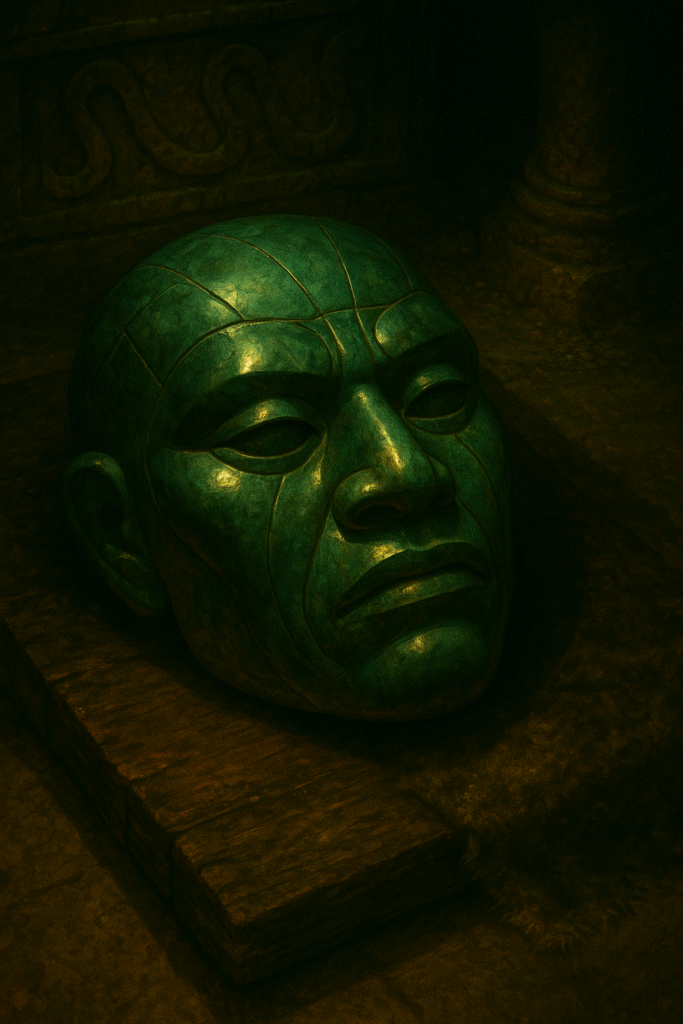
Quick Facts
Region of Origin: Mesoamerica — primarily ancient Maya (Palenque, Calakmul), but also Teotihuacan and Olmec roots
Also Known As: Royal Jade Mask, Funerary Jade Mask, Mask of Eternal Breath
Classification: Funerary relic / vessel of soul / royal transformation artifact
Primary Period: Middle Preclassic to Late Classic Maya (c. 600 BCE – 900 CE)
Material: Jadeite mosaic, shell, obsidian, cinnabar, hematite
Purpose: Preserve soul; ensure divine rebirth; proclaim eternal rule
Believed Powers: Soul binding, ancestral connection, protection against decay, dream-bridging
Introduction
Deep within jungle-wrapped pyramids, down steep stairways slick with time, lie chambers untouched by daylight.
Inside them rests a face—cold, green, and serene.
A face that never rots.
A face that never blinks.
A face that waits.
These are the Jade Death Masks of ancient Mesoamerica.
They were placed upon the dead not in mourning, but in coronation.
The ruler beneath did not belong to earth anymore—
only to eternity.
This mask is a promise:
that death is not an ending,
only a door.
And jade is the key.
Origins — Stone of Breath and Eternity
Long before gold was treasured, the Maya revered jadeite.
It was the color of new maize, young leaves, and sacred rivers—living symbols of renewal and the breath of divine creation.
Jade’s Sacred Meaning
To the Maya, jade was not merely stone. It was:
- Life made physical
- Divine breath trapped in mineral
- The heart’s eternal pulse
The word for “breath” and “soul” is linked to the same cosmic essence jade was believed to contain.
Placing jade over the face or mouth meant ensuring that the soul continued to breathe in the afterlife.
Birth of the Mask Tradition
Primitive jade face plaques appear as early as the Middle Preclassic (c. 600 BCE), but the tradition flourished in the Classic era.
Burials of kings and high priests feature masks crafted as idealized faces—calm, youthful, divine.
These masks were not portraits.
They were icons—transforming human rulers into living gods upon death.
Why Jade? — The Green Covenant
Jadeite was rarer than gold, harder than steel, and found only in select mountain veins. Its scarcity and celestial green color made it sacred.
It symbolized:
- Vitality
- Immortality
- Renewal through death
The Maya believed the universe itself breathed green—the color of maize, the blood of the earth.
To lie with jade was to return to the womb of creation.
Purpose — The Divine Transformation
A Jade Death Mask was not funerary decoration; it was technology of the soul.
Its functions included:
Preservation of Identity
The mask preserved the individual’s sacred face.
Even when flesh faded, the ruler remained recognizable to spirits and gods.
Ancestral Recognition
The deceased could join the ranks of the divine kings who came before—and guide the living.
Rebirth Through Deity Fusion
The mask often resembles the youthful Maize God.
To wear it meant rebirth, resurrection, and kingship beyond death.
Protection Against Decay
Symbolically — and sometimes physically — it guarded against corruption.
Political Immortality
Death could not dethrone a king.
He continued ruling through priestly communication and ancestral cults.
Appearance — Sculpted Godhood
No two masks are identical, but they share consistent sacred traits:
Base Construction
- Small jadeite tiles fitted together into a mosaic
- Gaps between pieces symbolizing transformation
Facial Features
- Eyes: shell, hematite, or obsidian
- Angular cheeks
- Slightly parted lips
- Expression: serene, otherworldly
The mask’s face is not that of a corpse.
It is the eternal face of the divine.
Color Code
The palette itself conveys cosmology:
| Material | Meaning |
|---|---|
| Green Jade | Life, breath, rebirth |
| Red Cinnabar | Blood, sacrifice, transformation |
| White Shell | Purity, celestial realm |
| Obsidian | Night, underworld sight |
| Hematite | Sacred power |
The green face and red dust together evoke life emerging from death.
Ritual Use — The Final Coronation
A king’s burial was not a moment of grief.
It was ceremony—orderly, cosmic, inevitable.
Priests performed rites in utter darkness.
Burial Procedure
- Body washed and scented
- Jade beads placed in the mouth
→ symbolizing the seed of life - Mask placed over the face
- Cinnabar scattered over body
- Body adorned with regalia:
- Earspools
- Pectorals
- Necklaces
- Jade teeth inlays
- Tomb sealed with offerings
The ruler entered the underworld not as a corpse,
but as a god dressed for continuity.
Construction — Made by Hands in Prayer
Jadeite is among the hardest stones on Earth.
Despite lacking metal tools, Maya artisans worked jade with astonishing precision using sand abrasion, cord drills, and stone blades.
The carving process was deeply spiritual:
- Stones were ritually “awakened”
- Offerings given before shaping
- Mistakes could mean spiritual failure
Each tile was charged with meaning.
Arranged into a face, they formed a cosmic diagram of the soul.
Famous Masks — Faces That Never Died
Pakal the Great — Palenque
The most renowned jade death mask belonged to K’inich Janaab’ Pakal, who died in 683 CE.
Features:
- Mosaic jade face
- Shell and obsidian eye inlays
- Linked to Maize God symbolism
Found in a sarcophagus beneath Palenque’s Temple of the Inscriptions, the mask asserts that Pakal was reborn as a deity, ruling beyond death.
Local folklore claims the tomb felt “warm” when opened, as though its occupant had only just left.
Calakmul Masks
Calakmul’s tombs yielded multiple masks.
One, associated with Yuknoom Yich’aak K’ahk’ (“Jaguar Paw”), carried jaguar symbolism—night sun, war, and underworld mastery.
These masks often retain cinnabar residue—
symbolic blood
still clinging
after over a thousand years.
Teotihuacan Masks
Older jade masks from Teotihuacan lack funerary attachment. Instead, they may have been:
- Passed between rulers
- Used in rituals
- Embodiments of founding ancestors
Their smooth, expressionless faces radiate a different aura—
impersonal, distant, cosmic.
Regional Variations
Maya (Classic Period)
- Mosaic tile construction
- Funerary use
- Deity fusion
Teotihuacan
- Carved from a single block
- Ritual object first, funerary second
- Aesthetic idealism
Olmec (Speculative Influence)
- Early jade portraiture
- Influence on later traditions
While not all jade masks were burial-related, the funerary type became the most spiritually potent.
Paranormal Accounts — The Eyes That Still See
The Jade Death Mask is not only an archaeological relic—it is a supernatural one.
Legends and Reports
- Faces that stay warm:
Some claim newly uncovered masks feel body-temperature warm. - Delayed decay:
Rare burials show facial tissue preserved beneath jade mosaics. - Dream invasion:
Those who view masks at night report dreaming of maize fields, roaring jaguars, or descending into stone corridors. - Breathing sounds:
Archaeologists occasionally report faint airflow near the mask’s mouth, though chambers are sealed. - Ancestral possession:
Indigenous traditions warn that gazing too long into the mask’s obsidian eyes invites the attention of the spirit inside.
Some call the masks sleeping kings.
Others call them open doors.
Symbolism & Interpretation
The Jade Death Mask embodies:
- Continuity
- Rebirth
- Identity beyond flesh
- Maize godhood
- Eternal rulership
Its meaning is cyclical:
- Life
- Death
- Resurrection
- Guidance of the living
It transforms the mortal face into one the gods recognize—
ensuring safe passage and power beyond the grave.
Cultural Legacy
Today, these masks appear in museums, protected glass coffins, and digital archives.
But unlike most artifacts, they retain a sense of presence—
as if someone still wears them.
Anthropologists treat them as fine art.
Local communities treat them as living ancestors.
They inspire:
- Books, films, and games
- Ritual reenactments
- Art and jewelry
- Occult speculation
Their image has become a symbol of:
- Ancient wisdom
- Spiritual continuity
- Unearthly calm
And the belief that
the face you die with
is not the face you keep.
Conclusion — The Green Face Waits
The Jade Death Mask is not only a relic.
It is a promise
spoken in jade.
That kings do not end.
They change.
That jade—which does not rot—
lends eternity to all it touches.
In the silent chambers of forgotten pyramids, the masks still lie, serene and perfect, their empty eyes staring upward, waiting for darkness to lift.
Some say that if you place your face against one,
you will feel it breathe.
Some say it remembers every face it has worn.
And some say the kings beneath
are not finished yet.
They are only waiting.