
The Hand of Glory — Flame of the Hanged Thief
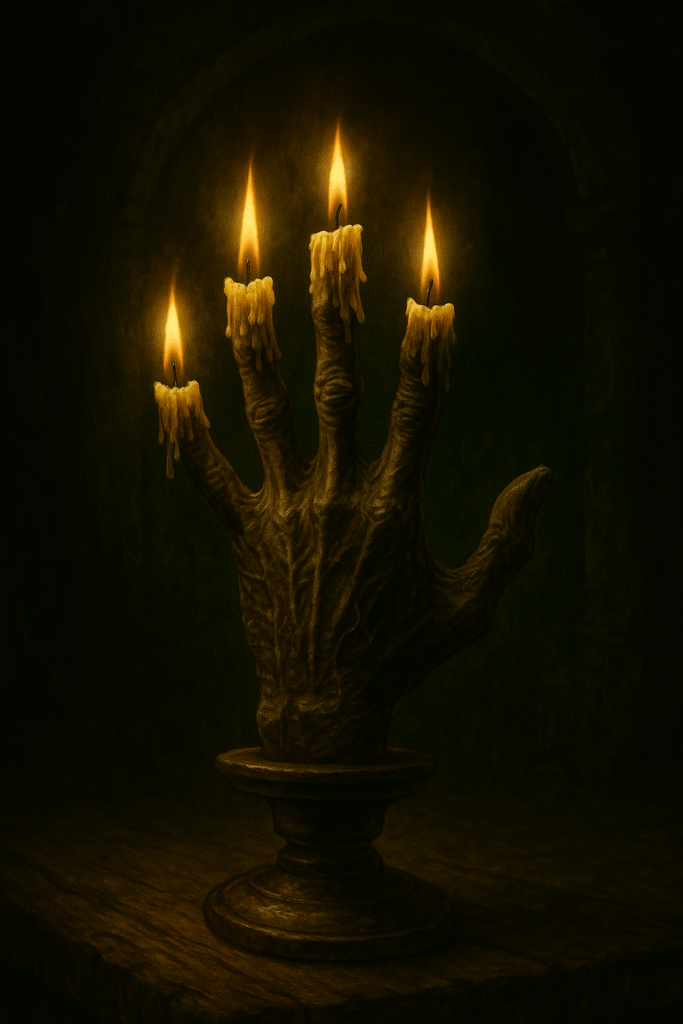
Quick Facts
Region of Origin: Europe — most strongly associated with Britain & France
Also Known As:
- La Main de Gloire
- The Hanged Man’s Hand
- The Candle of Thieves
Classification: Cursed relic / necromantic tool / immobilization charm
Era of Emergence: Late Medieval to 18th century
Primary Material: Desiccated hand of a hanged criminal, often clutching a candle made from corpse fat
Primary Use: Paralyzing households; opening locked doors; protection for thieves and witches
Alleged Powers: - Immobilization
- Lock manipulation
- Fire that cannot be extinguished
- “Dream paralysis”
- Necrotic contamination
Introduction
In the dead of night, beneath gallows where crows sleep and earth refuses to soften, thieves once sought a prize more valuable than coin — the severed hand of a hanged man. Dried in graveyard herbs and clasping a candle made from human fat, this grotesque talisman burned with a pale, unholy flame that neither wind nor water could quell.
Those who saw it lit said its glow made living bodies heavy, minds hazy, eyes glassy.
It froze households in silent terror, leaving only the intruder awake to wander freely.
Doors unlocked.
Fire would not burn against him.
Even dogs failed to bark.
This was the Hand of Glory —
the ultimate prize of grave-robbers, witches, and nocturnal thieves.
A tool not only of burglary, but of sorcery.
Origins — Born from Rope and Grave Soil
The Hand of Glory is a relic born of execution.
The Hanged Man
According to lore, only the hand of a criminal who died by hanging would do — especially if he was executed for theft, murder, or witchcraft. Death by gallows “charged” the body with liminal power, leaving the hand spiritually unclaimed.
At midnight, beneath the swinging corpse, the hand was:
- Severed at the wrist
- Wrapped in burial cloth
- Taken under cover of darkness
To steal from the gallows was a crime worse than theft.
But for those who believed in the Hand’s power, the risk was nothing compared to what it offered.
Ancestry of the Charm
Symbols of severed limbs appear in European and Middle-Eastern magical traditions — hands of martyrs, hands of saints, hands of criminals. The Hand of Glory likely evolved from older corpse-magic: the belief that the dead retained power.
Yet only in Western Europe did it become a weapon for burglars — turning entire homes into silent tombs while thieves emptied them.
Construction — From Flesh to Sorcery
The Hand of Glory required careful, secretive preparation, often guided by grimoires.
The Ritual
- Select the Hand
- Traditionally the left hand (the “sinister hand”)
- Or the hand that “committed the crime”
- Desiccation
- Washed with wine, salt, or vinegar
- Packed with herbs (vervain, fennel, rosemary)
- Sun-dried, lime-dried, or baked in an oven
- Sometimes buried in graveyard soil to absorb “earth of silence”
- Wax & Candle
- The hanged man’s fat was rendered into wax
- His hair used for wicks
- Candle placed in the hand OR each fingertip lit as a candle
- Consecration
- Words spoken at crossroads
- Sometimes invoking devils or spirits of the condemned
Some rituals required the hand be dried under the light of the full moon, or during a solar eclipse — when the line between worlds thins.
When complete, the Hand became a portable curse.
Appearance — A Candle of the Dead
The Hand of Glory is typically described as:
- A mummified human hand — blackened, skeletal, stiff
- Fingers curled as if still clutching something
- Skin like baked leather, cracked and pale
When lit:
- Flames burn blue, white, or corpse-yellow
- Fire emits little heat
- Shadows stretch unnaturally long
- The air smells of tallow and grave dust
Some accounts say each finger burns with its own flame. Others describe a single candle placed in the palm, burning with uncanny steadiness.
It is said the flames flicker only when spirits draw near.
Behavior — The Sleep of the Living
The Hand of Glory’s primary effect is immobilization.
Paralysis of the Household
When lit and carried into a home:
- All living within fall into deep, unmoving sleep
- Their limbs cannot respond
- Their tongues cannot speak
- Their eyes stare without seeing
This sleep is said to imitate death — breath shallow, heartbeat slow.
Only the bearer remains free.
No lock can resist him.
No alarm will sound.
Even animals remain silent.
Some stories go further:
Those with weak spirits die rather than sleep.
Selective Awakening
Occasionally, one person remains awake — usually someone protected by:
- Blessed charms
- Iron wards
- Baptismal relics
These rare survivors are said to feel crushing heaviness, unable to rise, only to watch the thief move through the house like a silent ghost.
Abilities
Paralytic Aura
Immobilizes sleepers; induces coma-like stillness.
Lock-Loosening Charm
Doors open.
Bolts slip aside.
No key is needed.
Undying Flame
Water cannot extinguish its fire.
Milk, holy water, and blood fail.
Only its own ritual extinguishing phrase will quench it.
Resistance to Fear Wards
Dogs and domestic animals do not bark or flee.
Spiritual Sight
Some claim the flames reveal:
- Ghosts
- Hidden spirits
- Footprints of the recently dead
Curse Transfer
Passing the Hand to another transfers its burden:
Depression, nightmares, hallucinations.
Countermeasures & Weaknesses
Only a few protections exist:
- Milk of a Black Cow
Said to extinguish the Hand’s flame. - Holy Words
Latin prayers; Psalms. - Placement in Running Water
Weakens the Hand’s curse. - Salt, Iron & Rowan
Break the paralysis in some accounts.
A simpler belief persists:
If the Hand is thrown at the feet of the thief, its power breaks — and he becomes frozen instead.
Historical Reports & Legends
The Sleep House of Whitby
A gang of thieves lit the Hand inside a farmhouse.
All fell silent — yet one servant girl saw them. Unable to move, she managed only to nudge a bowl of milk toward the flame. The moment milk touched it, the fire went black, and the thieves collapsed — paralyzed themselves.
The girl survived.
The thieves did not.
The Merchant of Bayonne
A French merchant awoke to see a stranger rifling his desk. He could not move; his very heartbeat slowed. The candle burned in a shriveled hand.
The merchant prayed — and the flame faltered.
The thief fled, leaving the Hand behind.
The merchant’s wife tried to touch it; her skin blistered.
That night, her dreams were filled with whispers:
“Hang… hang… hang…”
By morning, she was gone.
The Graverobber’s Curse
In Yorkshire, a man who made a Hand of Glory from his brother’s corpse used it to rob homes.
When his crimes caught up to him, he tried to destroy the Hand — but it would not burn.
He died weeks later, strangled by unseen hands.
When found, his corpse was rigid — right hand raised in an eternal, mocking gesture.
Associated Phenomena
Where the Hand dwells:
- Candles dim
- Windows frost
- Walls exude moisture
- Doors drift open
- Sleep becomes heavy
- Dreams become violent
Animals refuse to enter.
Infants scream without waking.
The Hand is often found wrapped in:
- Grave cloth
- Black thread
- Twisted iron nails
Touching it with bare flesh causes numbness, cold, or nausea.
Symbolism & Interpretation
The Hand of Glory embodies:
- Theft of death’s power
- Corruption of sacred remains
- Inversion of justice
Hanging was society’s punishment; the Hand weaponizes the punishment into a tool.
It symbolizes:
- Rebellion against divine law
- Domination of the living by the dead
- The idea that crime persists beyond death
Even now, folklorists note a recurring theme:
The person who wields the Hand eventually meets the same fate as the man who once wore it.
Modern Sightings & Possession
Rumors place surviving Hands in:
- Secret society collections
- Occult museums
- Private European vaults
Occasionally, a desiccated hand with waxy residue surfaces in an auction catalog, described simply as a “mummified curiosity.”
Such lots routinely vanish before sale — purchased privately.
Some believe the Hand is still used — not by thieves now, but by occultists seeking paralysis of will rather than body.
A crueler rumor claims Hands now choose their bearers.
How It Is Contained
To safely store the Hand:
- Wrap in burial linen
- Bind with three strands of iron thread
- Seal in a wooden box lined with salt and rowan
- Keep in a dry place
Never bring it near:
- Sleeping people
- Infants
- The gravely ill
It hungers for dreams.
And once it tastes yours, it returns.
Conclusion — The Fire That Will Not Die
The Hand of Glory is theft raised to sorcery — a criminal’s final defiance turned into supernatural weapon. Born from rope and grave dust, it transforms punishment into power, ensuring the condemned thief steals even in death.
Its flame does not warm.
Its presence stops breath.
Its purpose is silent entry, silent exit —
leaving nothing but stillness behind.
If you ever see a candle burning blue in a dead man’s hand,
do not pray.
Hide.
Because the flame will not go out.
And neither will you.