
Jorōgumo — The Weaver of Gentle Death
Quick Facts
Region: Japan (especially Izu, Gifu, and Edo-era cities)
Also Known As: Binding Bride, Woman of the Web, Whore Spider
Classification: Yokai / Shape-shifting predator spirit
Primary Origin: Magical spider that transforms into a woman
Typical Behavior: Seduces men, lures them to lairs, paralyzes and devours them
First Signs: Beautiful woman alone in the forest or playing music by a waterfall
Weakness (traditional): Fire; recognizing her true form before touch
Introduction
A flute plays beneath the falls.
Its melody weaves through mist and stone like a silk thread drawn tight.
And standing there — smiling, wet hair clinging to pale skin — is a woman dressed in red.
She asks for help.
She offers tea.
She sings while you rest in her home, legs strangely heavy, vision beginning to blur.
You never leave.
For this is no ordinary woman.
This is the Jorōgumo — a spider yokai older than steel and silk, whose appetite spans centuries.
Known throughout Japan as both temptress and executioner, the Jorōgumo is feared not just for what she is, but for how easily she isn’t.
This case file unravels her web — from origin myths and sightings to abilities, victims, and her enduring role in yokai lore.
Origins
Eight Legs, One Lie
The name Jorōgumo (絡新婦) means “Binding Bride” — a play on words that merges jorō (prostitute) with gumo/kumo (spider). The term once referred to real spiders like the golden orb-weaver (Nephila clavata), but evolved into myth.
Japanese folklore tells of spiders that, after living 400–500 years, gain supernatural powers.
The most dangerous of these is the Jorōgumo — a spider that learns to walk as a woman.
From the Edo period to the Meiji era, she was blamed for vanishing travelers and young men found mummified, wrapped in dense webs inside forests and abandoned inns.
Unlike the brutal oni, she kills with patience.
Unlike the mournful yūrei, she does not grieve.
She waits.
And when she moves — it’s already too late.
What Creates a Jorōgumo?
Folklore offers two paths:
- A magical spider who attains power through age and transforms into a woman
- A cursed woman fused with a spider through vengeance, sorcery, or karma
In both tales, the result is the same:
A beautiful woman whose home — or heart — hides a cocoon of death.
Appearance — Silk and Skin
From a distance, the Jorōgumo is breathtaking.
The Lure
She appears as:
- A woman in her twenties
- Wearing red or floral-patterned kimono
- Hair dark and wet, often combed to one side
- Voice soft, melodic — sometimes singing or playing shamisen or flute
- Often seen alone near waterfalls, shrines, or bridges
She always smiles.
She always invites you in.
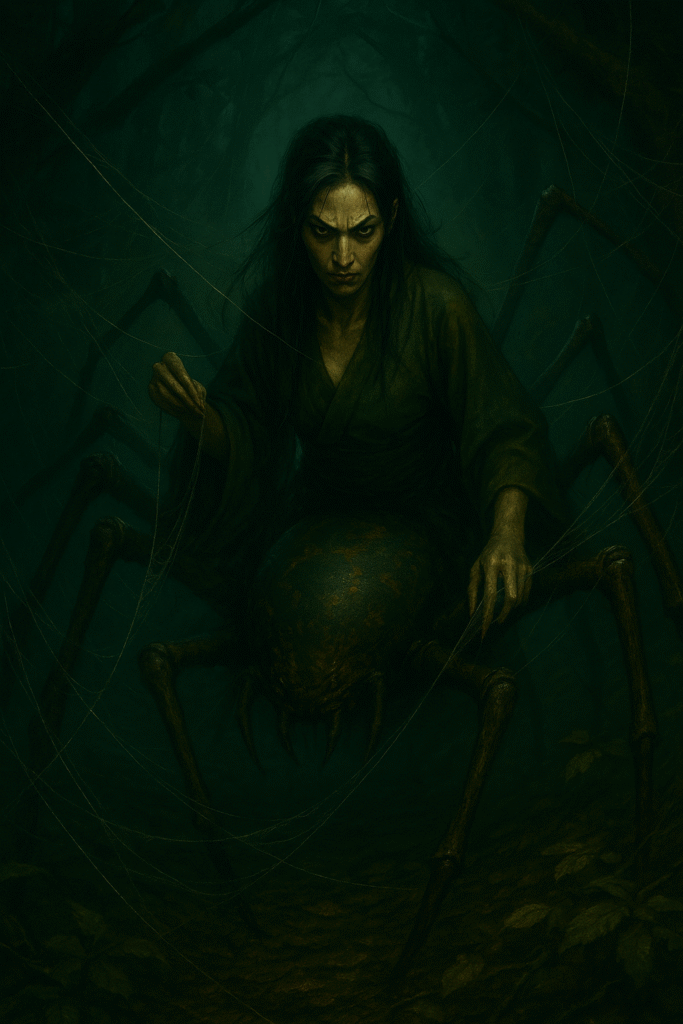
The Truth Beneath
If revealed or angered:
- Her mouth splits open
- Her limbs lengthen, joints bending backward
- Her eyes multiply across her face
- Hair twists into leg-like appendages
- Her back splits open to reveal chitin
- Fangs emerge from red lips
- Threads spool from her fingertips
Some accounts say her lower body remains that of a spider — legs the size of tree branches.
Others claim she appears fully human — until it’s too late to move.
Behavior — A Web Made of Men
The Jorōgumo doesn’t hunt randomly.
She selects.
She preys on:
- Proud warriors
- Traveling monks
- Poets, merchants, lonely men
She often targets men who overestimate themselves, especially those who mock women or believe themselves immune to seduction.
Preferred Settings
- Forest paths, especially near waterfalls
- Old shrines with broken lanterns
- Tea houses that reopen under new names
- Forest inns no one remembers building
Typical Pattern
- Victim hears music or soft singing
- Encounters a beautiful woman asking for company
- Accepts drink or enters her home
- Begins to feel weak — legs go numb, eyes blur
- Tries to leave but cannot
- Web descends from ceiling
- Darkness
By morning, he is gone.
Or what remains is husk-like, face frozen in ecstasy and horror.
Abilities
Shape-Shifting
She can switch seamlessly between spider and woman.
Some say she walks with eight shadows when the sun is low.
Paralytic Thread
Her silk carries venom that dulls the senses.
Even when not visible, her aura can weigh down limbs and slow thoughts.
Illusion & Hypnosis
Victims often don’t notice time passing.
A night in her home may have been a week.
Some men return home… and collapse into dust.
Summoning Spiders
She commands thousands of smaller spiders to spy, lure, or wrap prey.
They travel in her sleeves.
Immortality (in some tales)
Older myths suggest she cannot die by ordinary means.
Only fire, sunlight, or exorcism may banish her.
Regional Variants
Jōren Falls, Izu Province
This is her most famous lair.
Legend says:
- A young man fell in love with a woman who played music by the waterfall
- He vanished
- His family sent searchers
- They found his clothes, skin, and bones
- A priest later saw threads falling from the cliff — and a beautiful woman smiling above
Even today, some locals warn travelers not to stop by the falls alone after dusk.
Gifu Region
Home to an 800-year-old cedar tree said to house a spider spirit.
Locals believe hearing a shamisen in the forest means the Jorōgumo walks.
Edo-era Brothels
Some urban legends claim abandoned brothels became hunting grounds.
Men lured by “special women” vanished.
The buildings were burned to the ground. No bodies were found.
Modern Sightings
While belief in yokai has diminished, the Jorōgumo lives on:
- In manga (e.g., GeGeGe no Kitarō, Mononoke)
- In games (Nioh, Shin Megami Tensei, Sekiro)
- In urban legends across Japan and Reddit forums
- In cosplay and horror haunts
Paranormal accounts still emerge:
Young hikers going missing near waterfalls.
Hushed stories of women who live alone, never age, and never let guests leave.
Cultural Significance
The Jorōgumo reflects:
- Fear of female power
- Anxiety over seduction, sex, and entrapment
- Nature’s beauty hiding danger
- The thin veil between hospitality and predation
She is both feared and admired —
A figure of independence and danger in one.
Protection & Weakness
Traditional Safeguards
- Do not speak with strangers near waterfalls
- Avoid drinking tea or alcohol offered by a woman traveling alone
- Burn incense or carry charms when walking mountain trails
Weaknesses (in folklore)
- Fire — said to banish spider spirits
- Reflection — some tales say her illusion breaks in mirrors
- Naming her — recognizing the Jorōgumo aloud may weaken her glamour
Symbolism & Interpretation
The Jorōgumo is a cautionary tale:
- About lust clouding judgment
- About the masks predators wear
- About how nature and femininity were both romanticized — and demonized — in Edo Japan
She also speaks to a deeper fear:
That something ancient still watches us — through charm, through beauty, through silk.
Why Her Legend Lives
She embodies contrast:
- Beautiful / monstrous
- Gentle / cruel
- Intimate / alien
She is remembered because her story warns in whispers, not screams.
A death not by sword — but by smile.
Conclusion
The Jorōgumo waits by the waterfall.
She brushes her hair.
She hums softly.
And when the right man passes — not too clever, not too careful — she reaches out.
Most yokai fade when forgotten.
But she…
she weaves her name into each generation.
And her web is always waiting.